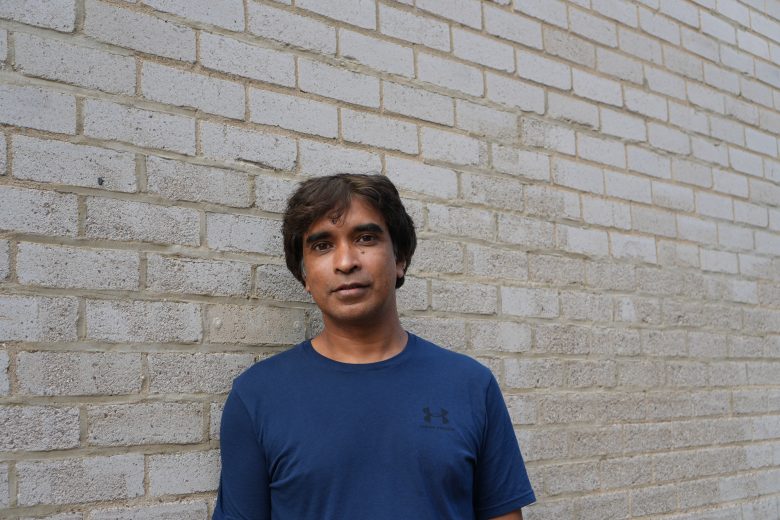
Photo of Mothiur Rahman by Tasnim Siddiqa Amin on Hanbury Street (2026)
Meet Mothiur Rahman, our newest East storyteller. Originally from Leeds, Mothiur came to London in the early noughties, where an unexpected act of kindness would begin to change the way he understood his own story. A lawyer and environmental law lecturer by day, his creative practice is rooted in finding space for stories that might otherwise go unheard.
In this Spotlight, Mothiur reflects on storytelling, migration, belonging and the role creativity can play in making sense of our lives. You can read his interview below or listen to it here:
What does storytelling mean to you?
Well, my own story is about an act of kindness where a friend who I accidentally bumped into after a 12-year break sat me down and asked me, ‘Well, what has been your story over the last 12 years?’
There was a kindness in how she presented the question that felt really inviting and heart-opening. I was going through a particularly tumultuous time and, as I began to try to piece together my life over such a long period to respond to her question, I suddenly began to see the tumultuousness in a different way, saw it connect to threads in that 12-year period I hadn’t seen before.
It allowed me to find a narrative that began to shape a new sense of who I had been becoming all along, that perhaps the tumultuousness in my life was not certain events happening, but my response of trying to resist those things happening because the inner critic in my head was saying (or rather shouting!) “this is not how I had planned my life!”. I began seeing that perhaps these events were actually allowing parts of me I had learnt to suppress to have an opportunity to speak. This shift in perspective quietened the tension and resistance in my body and, as if by magic, things stopped being as tumultuous!
So storytelling for me is the inherent capacity in each of us to find meaning in each of our lives, to create or rediscover the anchors for steering and containing our own lives. And creating the space for storytelling is giving people the inspiration that can let them know their story is worth being discovered and listened to too.
Tell us about your creative practice
I hope to develop a piece that could come out from this story that is a broader story of migration and joint identities. Whenever I read out my poetry, people say you should do more of that. So I have begun to see myself as a spoken word artist. I like performing not just in spoken word events where there’s already an audience for those kinds of things, but mixing it with narrative so that it can extend into different kinds of spaces and conversations. I like working with spoken word to help envision different kinds of futures for myself and others, or to help host group conversations that can inspire and bring out the creative in other people as well. I have brought spoken word to my environmental activism through talks, also to a dance/movement workshop and loved seeing different creative practices touching into each other in that way!
What does East Storytelling mean to you?
Well, there are two things that I feel inspired by. One, often ordinary people don’t get to tell their stories, and so by enabling and giving space for ordinary people to tell their stories, something rich can come out.
Secondly, migrant communities are often marginalised. So giving space to their stories provides a rich seam of potential that I’m really grateful to be part of. I feel a community of like-minded souls with similar interests and identities which is looking to kick out, speak up, and live. in their own way.
What are you currently excited about creatively?
My paid career is as a lawyer and legal lecturer in environmental law. I am working on a project to open up people’s imagination to the biosphere beyond the concept of the environment to the planetary biosphere as a whole. That needs us to imaginatively grasp the sense of the whole planet, not just personhood but ‘planetary-hood’. Hood is an old English word meaning state of being. So we have neighbourhood, brotherhood, sisterhood, personhood. But “planetary-hood” requires us to really grasp imaginatively beyond the concepts we know, to create new words and new neologisms like ‘planetary-hood’ that could help us to open into new ways of relating to our planet .
Mothiur has just begun putting together a digital platform for his spoken word/poetic output. You can find the link here (supported with artwork from his brother Mujib Rahman!)