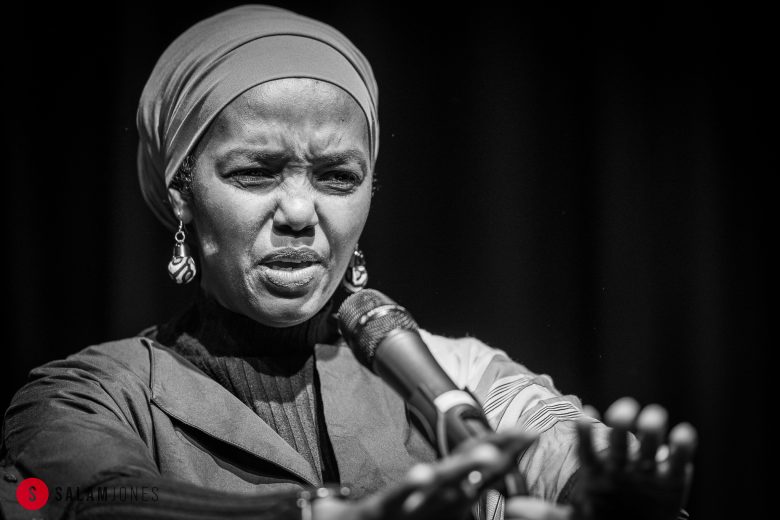
Photo of Kauthar at East to Elsewhere by Salam Jones (2025)
Our third East spotlight is on secondary school teacher, mum and storyteller Kauthar Abdi. Tasnim Siddiqa Amin had a chat with Kauthar about her rich Somali cultural heritage and what she’s learned from her engagement with the East Storytelling Project, from her first workshop with us in 2021 through to her first paid performance last November at A Season of Bangla Drama festival 2025.
Listen to the interview here.
Tell us about yourself
My name is Kauthar, a secondary school teacher. I’m a mum. I was about 20 years old when I experienced Islamophobia, and that made me go into a world I never imagined, which is becoming [a] really strict Muslim, wearing the veil and that took a while for me to come out of and, in a way, I needed to get out of the relationship I was in in order to get out of that. That’s been quite a journey, and coming out of that made me feel like I had stories to tell, and I’ve always felt like there’s stories I want to share. I grew up with oral storytelling, Somali folk tales, and that was my most wonderful memories as a child.
Have you got any specific memories of the kind of oral stories or the folk stories that you can share with us?
There’s this one story called Dagdeer, and my mum used to tell us […] every night we had the expectation that my mum would tell us a story and frighten us to sleep. She has a very long ear, she can hear naughty children. Like the witch in Hansel and Gretel, she wants to eat them and then they always escape in the same way that Hansel and Gretel escape.
My dad used to sing to us as well. He was part of the national band, he’s a composer and a singer, and I never really understood that until recently, talking to him. He used to play the oud for us before bed at night time and tell us stories as well.
I grew up with oral stories, and we didn’t have a lot of books, but when we came here, most of my siblings and I had that rich culture of storytelling and poetry. I grew up with my grandmother reading me a poem about myself, it’s called burambur, and burambur is like spoken word. She was celebrating me, how beautiful I am and how men were just in awe of my beauty, and they came from far away, and they couldn’t eat their food, they lost their appetite. I did a workshop about how Somalis have this rich culture of oral storytelling, and it shouldn’t be a hierarchy of having physical texts, then just make the assumption that other cultures don’t have stories.
Sounds like you had such a rich upbringing, like a concert every night by your parents.
I had poetry, I had storytelling, I had music and my dad spoke multiple languages, so this is the kind of thing that as an English teacher, when I started in the industry, it’s made to seem like other cultures are devoid of those things and that somehow inherently as an English teacher I’m supposed to push for cultural capital from an English point of view and children should have books and x, y, and z, but actually if I choose to tell kids go home and come back to tell me the stories that you tell and to get them to realise actually what I’m asking them to revel in what is already there in their cultures.
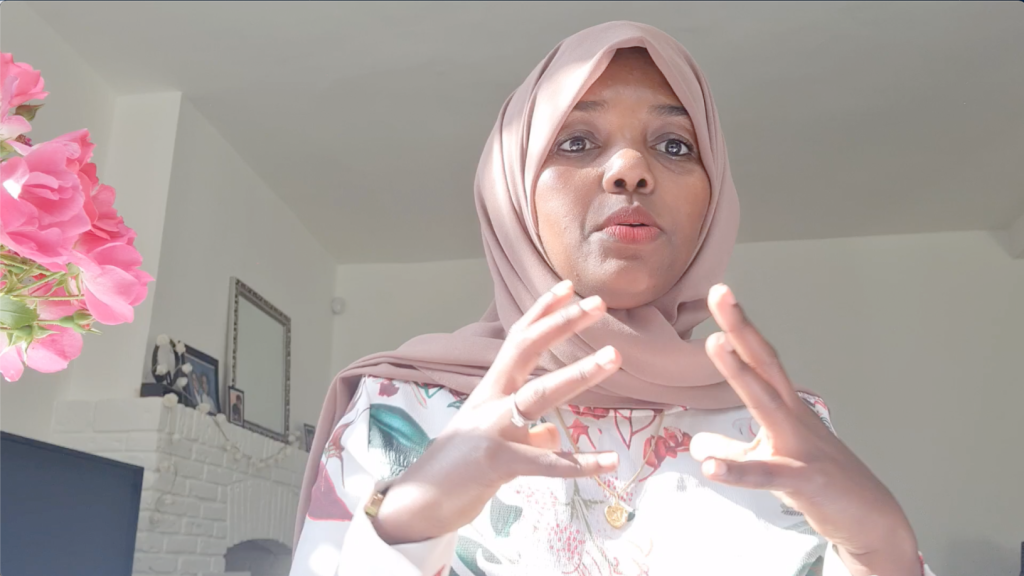
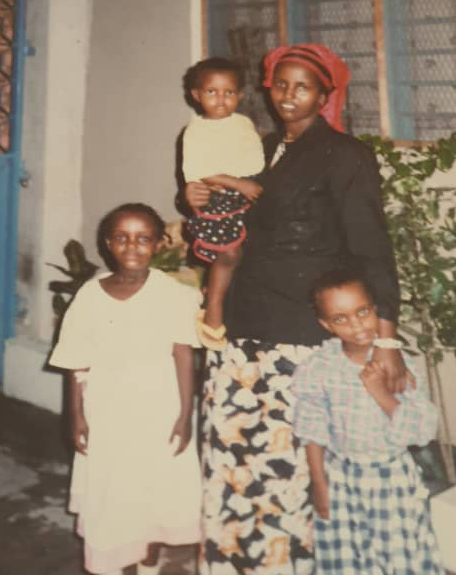
Left: Screenshot of In Search of Safety and Security, Kauthar’s first entry on the East Voices video archive in 2021. Right: Kauthar as a child in Somalia.
How did you hear about the East project?
I came across an ad for East Voices, and it was advertised by a Somali group called Numbi Arts, and I thought it must be like an East African storytelling thing. I was really excited, and I kind of contacted people and then, it wasn’t, it had nothing to do with [Kinsi].
What did you learn from the East Storytelling Project?
Before doing the workshop with Sef and Paul, I didn’t think I had stories to tell that had a beginning, middle and end. People would [say] you’ve got such great stories, but I never thought of them as a story because it wasn’t anything I could perform. So doing the workshops helped me see that you can curate your stories. You can work on them, cut things, tell things in a specific way. [Fellow storyteller] John [Heyderman] helped me by saying, [ask the audience] “Where were you on the 7th of July 2005??” That’s sparking the audience to engage and get them to think about where they were and then [that] gets them excited about [where I was that day].
So those creative things, even though as a literature person, I know how to do them in text, but when you’re telling your own story, you have this desire to tell everything. But actually, oral storytelling is an art form [where] you have to make choices and select things and enhance things and cut things. I remember, after my workshop with Seth and my story was coming to life [for] the first time, I remember saying to my husband, “Oh my God, it’s a narrative”.
Something that I also learnt the last time we worked together was [when] Paul pointed out sometimes when I’m telling my story, even though the story is gripping, I go out and do explanations. For example, when I said, “Oh, there were no maps. So somebody told you go left, right, blah, blah. You just had to remember.” And then I would go out of the story and say, “it was the days before Google maps. Now Google maps makes everything so easy.” That’s an extra explanation that’s unnecessary. So it’s been really good to be concise, just focusing on the story, that the story is the story, and everything else that doesn’t belong in it doesn’t need to be there.
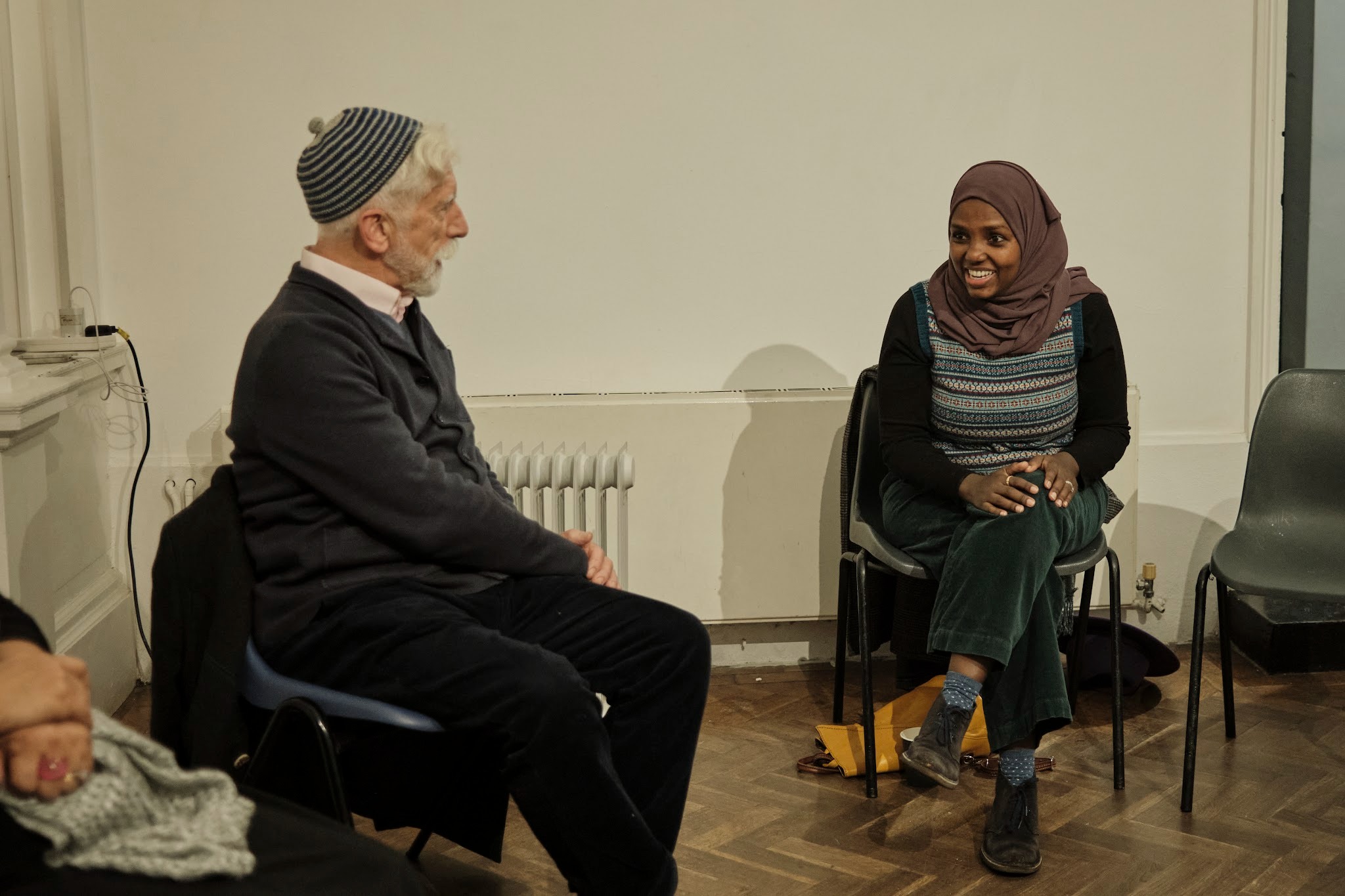
Photo of Kauthar at an East Social at St. Margarets House in November 2023 by Kushagra Anand.
And how has being part of the East project affected your creative practice or your career, if at all?
Oh my God, I mean, working with you guys has really made me feel like I am an artist, like when you guys contacted me and sent me a message and I saw you guys was it back in November 2024 [at the East Social in St. Margarets House].
I was like, Oh my God, I can’t believe it. I’ve only told one story. I’m nobody but doing that with you and [having the theme of] kindness and having me think about that, it’s changed [how] I see myself. Any opportunity I get now to tell a story on the stage, I take it, I’ve done two Moth slams and the first one was totally impromptu. I didn’t practise. I was nervous and I just wanted to stand on the stage and I was blown away by the audience’s reaction to me telling this very impromptu story and making them laugh. And I came seventh. And then I went back again, I think it was December after our [East to Elsewhere] show and I came fifth and that’s given me so much confidence and all because I’ve worked with you guys. I’ve even [been] asked to be in part of the UCL fringe variety show.
Wow, that’s amazing.
I can’t wait to do it. I’m going to tell the same story I told at the Bangla festival. And I’m just like, the fact that I’m taking any opportunity to tell my story is because I’ve worked with you guys. I don’t think before then, like when you said you’re going to pay me, I was like, what? This is crazy. I remember you said something really powerful to me. I was like, I’m just happy to have the space to like work with you guys. I can’t believe you’re going to pay me. And then you were like, well, we wouldn’t be able to have any show if [we] didn’t have the artists and when you said that, that really made me think differently about myself.
I think there’s so many people out there who don’t know about things like this. And I try and tell people, there’s this group if you ever want to tell a story, absolutely go for it. But obviously, everybody comes to things in a different way, don’t they? But I just think it’s, it’s so amazing to have a platform that can help people like myself, like a mum who was working all the time, who’s got little children. There isn’t time to pursue your art, you know? Even if you think you have the desire, or you’ve always had this wish that you want to do this artistic thing. It’s so good to know that there are spaces that help you build confidence, practise, I’m just so grateful. It changed my life.
What are you currently excited about creatively?
I contacted the UCL Fringe Festival coming up, I filled out the form, even though the form looked very much like it was for productions, you know, like an hour and I was like, well, I’m not a director, but I’m still gonna squeeze myself in here, and they can always get back to me. And they did, and they asked if I wanted to be part of an open mic or a variety show. So they’re doing a variety show, and they’re going to get back to me where, what theatre, they’re going to be using, which I’m really, really excited about.
You can watch Kauthar’s most recent story, filmed at A Season of Bangla Drama 2025, on our East Archive website, here: