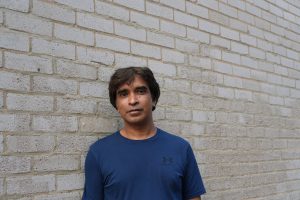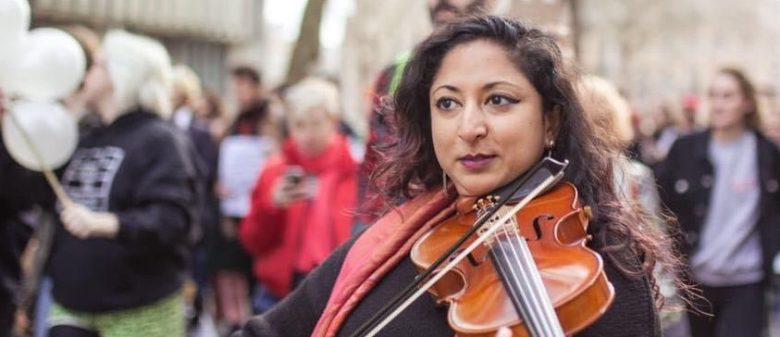
Queer musician, activist and academic Maya Bhardwaj joined the Black Smock Band for our Queer Revolutionary Singalong earlier this year. Growing up in the US, the songs she shared with the audience drew from her own experience and from her solidarity with Black American activism and revolutionary musical tradition. Read on to learn more about Maya’s incredible life, music and activism around the world before settling in East London, where you might find her teaching songs at protests.
Tell us about yourself and your creative practice.
I’ve been lucky to play the violin since I was 4 years old. This was thanks in large part to my mother, who put me into lessons where we were living at the time, the Appalachians in Virginia, also known as the home of bluegrass, a working-class music style forged through the meeting between Irish and English workers and Black African enslaved folks, where the fiddle plays a huge role. I trained in Western Classical but learned stylistic elements from bluegrass, and was also steeped in jazz and the Blues when we moved to Detroit, where I spent most of my youth. I also sang from a young age, casually and later slightly less casually, in choirs and musical theatre. I burned out on Western Classical education early, though, as I found the focus on endless hours of rehearsal, hyper-competition, and emphasis on perfecting exactly what was on the page to be overly dogmatic and stifling. My early music educators were amazing, though!
I gave up the violin for some years while in university, and came back to it really after meeting an amazing violinist in Cuba who was the frontwoman of an incredible Cuban jazz band, who encouraged me to re-learn in an improvisational style. I worked with an amazing improvisational coach and bluegrass and jazz violinist in New York while I lived there, who really re-built my comfort in feeling into the music and going with the flow in a collective way. I also worked briefly with two amazing Carnatic violinists in New York as well, and then studied closely with Celtic violinists and Cuban jazz musicians in the UK, Mariachi and Son Jarocho musicians in Mexico, South African jazz and maskandi musicians while I lived in Johannesburg, and some incredible Bangla musicians while I lived in Dhaka. Like my life, my creative practice has been all about picking up the influences of the diverse cultural spaces in which I’ve been privileged to live, figuring what works for me, and building a bit of an eclectic soup.
I’m also deeply involved in activist, political, and social movement work, and my creative practice is inseparable from this, and the lifelong struggle for justice and liberation for all those marginalised by capitalism and cisheterophobia (forgive the mouthful!). I’m deeply impacted by Gramsci and other cultural theorists like Stuart Hall and Paul Gilroy, who trace the impact of arts and culture in liberation struggles and forming new cultures of resistance.
What kind of research do you do in academia? What drew you to academia?
My work focuses on social movements, queerness, South Asian diaspora, racial politics, and leftist resistance. I spend time with activists, community organisers, and cultural workers like artists and musicians whose work focuses on the politics of liberation – whether in resistance to borders, prisons, police, unfair housing systems, worker exploitation, or patriarchy and queerphobia. I came to activism after working in organising for a decade, and I saw academia not as a move away from social movement work but as a way to think about the questions that animated our politics, more deeply. For example, how do we fight the rise of South Asian right-wing politics, in the subcontinent and the diaspora, and instead frontload liberatory resistance in both places? How can queerness create space for more cross-racial solidarities that seek to make new worlds? Being able to work alongside organisers to both make the world we want to see through protest and community space, and then being able to read and write about this work in a broader context, is what drew me and keeps me interested in academia.
What does being queer mean for you?
There’s a great bell hooks quote that talks about queerness as being in tension or opposition with the world as it is. That’s what being queer means to be. Of course, it encompasses who we love, or want to have sex with, but I think that queer politics and culture at their heart are a rejection of what is expected, a rejection of the norm, to create different ways of doing life.
How did you get into activism?
I came into activist work through growing up in Detroit and learning from incredible Afrofuturist Black American activists, as well as powerful worker organisers and Jewish anti-zionist leftists. I was first politicised through organising against anti-Blackness, racist policing, and the school-to-prison pipeline, but I was really trained up as an organiser first in electoral organising, which has both its opportunities and challenges. My family was rooted in anti-imperialist organising in South India, though, and I moved back to India in my early 20s to work with a feminist and antifascist organising space right prior to the BJP’s consolidation of power, which really shaped me as a feminist, antifascist, and abolitionist. I came back to the US in the midst of the first wave of Black Lives Matter organising and became deeply involved in racial justice and housing justice work, which took me back to my roots in Detroit, as well as working more alongside working-class-led South Asian American resistance spaces in New York. Activism and organising can be projects of heartbreak, but they’re also the things that, like music, give me hope in what humans can do and be when we work together.
Tell us more about your music influences
I’m most moved by musical traditions that feel both rooted in where they’re from as well as influenced by global movement and exchange. The idea of the Black Atlantic, from Stuart Hall, and also the Brown Atlantic, building from that, are concepts of interplay that move me musically, culturally, and politically. I love Caribbean and Caribeño music, for example, for that reason, and that remains a big part of my life today – shout out to Orquesta Estalar, London big band! Similarly, South African jazz is shaped both by the incredibly rich and diverse South African musical tradition, as well as its interplay with the Black diaspora and the movement of South Asian and other communities in South Africa. But Celtic trad and bluegrass are also examples of this! I love improvisational and live music of all sorts, music that lets us create together, and anything that gets us up and moving together, which I also wrote about here. Carnatic ragas were always playing in my house as a child, and definitely form a strong influence – another improvisational technique – and I was deeply moved by learning more about Qawwali and Baul while living in Mumbai and Dhaka, respectively. I think the kora is one of the most gorgeous instruments ever, and I love the Senegalese, Malian, and other West African musical forms that incorporate it. And I have a soft spot in my heart for electronic dance music, from house and techno (shoutout Detroit and Chicago) to Amapiano, and for pop and some forms of rock, basically any music styles that transmute human emotion into collective movement.
How did the Black American struggle shape you?
The story of Detroit is in many ways the story of Black America – grit, excellence, genius, and state disinvestment and violence. It was impossible to live in Metro Detroit and not be shaped by the story of Black American resistance and resilience. Detroit also teaches important lessons of Black and Indigenous solidarity in the face of Indigenous erasure, and Black and Asian solidarity, especially through the legacy of Grace Lee Boggs. However, South Asians in diaspora, including in the US, are often pitted against Black communities, in the falsehood of the “model minority myth” where Asians are characterised as more docile and less rowdy. Part of what brought me to the UK, and later South Africa, was the deep history and presence of rebellious South Asian communities who went against this, and worked in deep partnership with Black resistance – something that existed in the US as well, but was often occluded by caste violence and middle-class sensibilities. Musically, everything I grew up on was influenced by Black American artistry, from jazz to rock to punk to blues to bluegrass and everything in between. It’s impossible to find music in the US that isn’t shaped in some part by Black American musicality. The Black American diaspora is incredibly diverse and varied, but I would say that my friends and comrades teach me every day about finding joy in the face of deep pain, and threading resistance through relationship, care, and, as Robin DG Kelley calls it, freedom dreams. This work is hard, and I don’t always get it right, but I’m always grateful for these lessons.
Why sing songs at protests? What is the power of music in activism?
Music brings us together and allows us to feel present, embodied, and connected. There used to be a great training module from an excellent organising space in the US, Momentum (no relation to the UK Momentum), entitled “why don’t we sing at protests anymore?” In that space, we’d bring a bunch of activists and organisers together to write music about our resistance – and it was always one of the most joyful and hopeful organising spaces. In South Africa, singing and dancing is a huge part of the activist tradition, and I think it gives people a way to feel part of something that is both militant and generative when out on the streets. And singing songs brings in artists and musicians who form a key part of music work. When we sing, we learn to work together in a way that’s lived in the body, rather than getting stuck in the thinking part of the brain – and that allows us to do different work together.
Tell us about a project you are working on at the moment that excites you.
I put out a demo tape with the amazing hard work of some incredible friends, which was really exciting to work on, and quite chaotic due to my own surge of energy. I experiment more with singing on it, which felt silly and scary but also super fun, while also playing the violin. I currently play with two big bands, Flotsam Collective and Orquesta Estelar, and I’m really excited about growing more smaller musical collaborations, whether as one-off projects or potentially starting a longer project like writing an album or forming a band. I’m drawn to making, writing, and performing music that feels like it fits the strife and hope of the moment, politically and creatively, and am deeply moved by being able to do this communally. Hit me up if you want to collab!
Can you recommend a protest song that really galvanises a crowd?
Alright by Kendrick Lamar, Free by Nina Simone, Hum Dekhenge from Faiz Ahmed Faiz, and Shona Malanga are always ones that get crowds fired up. Check them out.
Find Maya on Instagram @mbhardwaj225. Listen to her album “The Time of Monsters” here.