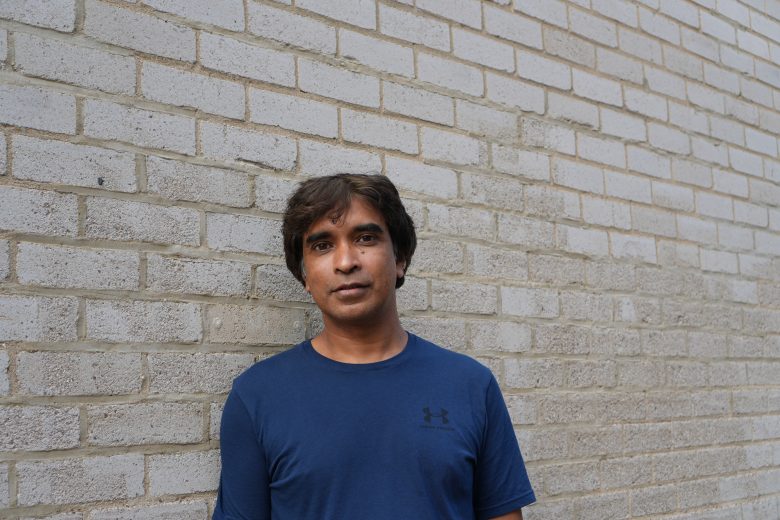
Photo of Mothier Rahman by Tasnim Siddiqa Amin on Hanbury Street (2026)
Meet Mothiur Rahman, our newest East storyteller. Originally from Leeds, Mothiur came to London in the early noughties, where an unexpected act of kindness would begin to change the way he understood his own story. A lawyer and environmental law lecturer by day, his creative practice is rooted in finding space for stories that might otherwise go unheard.
In this Spotlight, Mothiur reflects on storytelling, migration, belonging and the role creativity can play in making sense of our lives.
What does storytelling mean to you?
Well, my own story about an act of kindness is how it was so surprising and yet so heart-opening for me when someone sat me down and asked me, what is your story over the last 12 years?
It allowed me to tell and find a narrative that began to make sense for me out from all the different experiences that had happened that didn’t make sense when I had adopted other people’s ways of looking and not had time to really sit down and speak from my own heart, my own life and my own experience and be given the space of compassion and deep listening to open into.
So storytelling for me is the inherent capacity in each of us to find meaning in each of our lives to create our own anchors and steering for our boats that we have made through our own lives. And creating the space for storytelling is giving people the tools, the space, the listening and resources to let them know that their story is worth listening to too.
Tell us about your creative practice
Whenever I read out my poetry, people say you should do more of that. So I have begun to see myself as a spoken word artist. I like performing not just in spoken word events where there’s an audience for those kind of things, but mixing it with narrative, with workshops, doing it at the beginning of conversations. Say I’m in a men’s group, for example, using poetry to help ground, to inspire, to bring out the creative in other people as well. I see creativity everywhere, the potential for creativity in working with other artists, with music and dance.
I love five rhythms, other practise, movement. I love theatre and hope (1:28) to develop a piece that could come out from this story that is a broader story of migration and joint identities.
What does East Storytelling mean to you?
Well, there are two things that I feel inspired by. One, often ordinary people don’t get to tell their stories and by enabling and giving space for ordinary people to tell their stories, something rich can come out.
Secondly, migrant communities are often marginalised. So giving space to stories from the east, meeting here in this western land that we live in, gives a rich theme of potential that I’m really grateful to be part of, to feel a community of like-minded souls and people with similar interests and identities covering marginalisation that is looking to kick out, speak up, live. in their own ways found through whichever art form has been, whichever art form is most inspiring for that person.
What are you currently excited about creatively?
My paid career is as a lawyer and legal lecturer in environmental law. I am working on a project to open up people’s imagination to the biosphere beyond the concept of the environment to the biosphere as a whole. That needs us to imaginatively grasp the sense of the whole planet as what we could call personhood or planetary hood. Hood is an old English word meaning state of being. So we have neighbourhood, brotherhood, sisterhood, personhood. But planetary hood requires us to really grasp imaginatively beyond the words we already have to create new words, new neologisms that will allow us to open into new ways of looking at this source of life that is our own source of life.