Artist Spotlight

Artist Spotlight: Marshall Savage

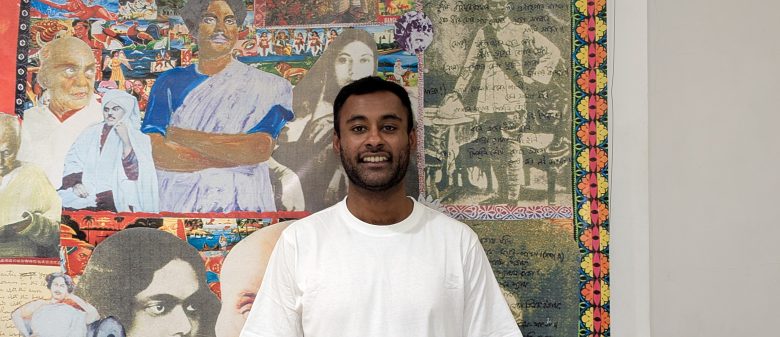
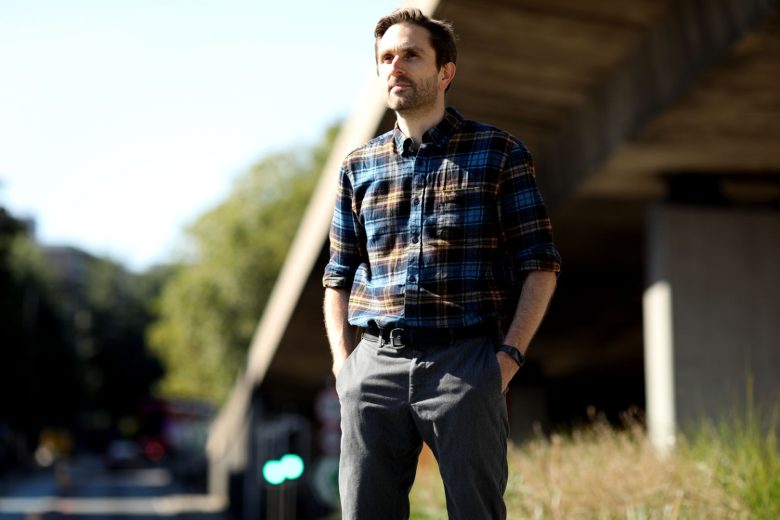
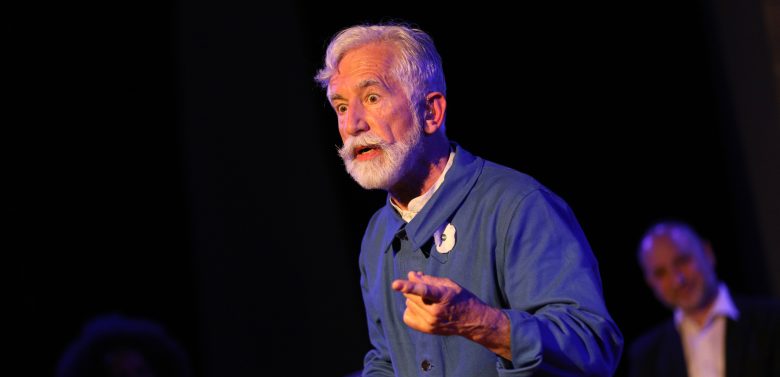
Photo of Marshall Savage at Kobi Nazrul Centre (2025)

Marshall Savage, also known as Mijan, is a Bangladeshi-British queer person from Bow. Marshall is passionate about LGBTQ+ rights and welfare not warfare. Marshall doesn’t come from a creative or academic background, but he loves learning new skills and embracing new experiences wherever they lead him. He is the newest member of our East Storytelling Project. 

After a late evening of rehearsals for our latest East production EAST TO ELSEWHERE, local trade unionist Marshall and assistant producer Tasnim sat at Chaiwalla on Brick Lane with a coffee and roti to talk about the East End, activism and the importance of sharing stories of migrant women. 


Tell us about yourself.

My name is Marshall, I’m born and raised in Tower Hamlets, in Bow specifically. I work for Tower Hamlets and I’m also a Trade unionist. I’m very heavily involved in activism, especially local activism and organising against the far right 

Fun fact?

I am obsessed with vampires.

What makes the East End such a rich source of stories? 

The East End is an amazing place; it was always seen as the armpit of London, where all the immigrants were shoved that no one wanted to deal with, from the Jews to the Irish to now the Bengalis. We have this incredible knack of creating a community wherever we are. Now Tower Hamlets and the East End are probably the most diverse cultural places in London, if not the world. 

And how does your specific heritage influence the way you see the East End?

The way my parents migrated into this country and the struggles they faced, and me being an immigrant and queer, made me realise what it means to fight for equality, to fight for what’s right and look into the intersection of what it means to be a brown queer person. 

What is storytelling? 

Storytelling is sharing really important parts of your life, it doesn’t have to be word to word, it doesn’t have to be fact by fact, it’s how we interpret how we experience life. It matters because it’s the best way to share information, look at history, travellers, they are the best way to tell stories, how we connect with people, how we get people from different places to understand each other. 

Why is it important to tell your mum’s story?

I feel like a lot of women of colour came here slightly unheard. My mum came here without any connections, she had to build her own community and that is a story worth telling, it is the story of many mothers and many women who came not just to London or England but who migrated to other parts of the country or other parts of the world, who stuck out and didn’t have a voice for themselves. 

What has been your experience of the East Storytelling Project so far?

I walked in there not knowing what to expect. I thought I’d see more brown faces. 2 Jewish men, a beautiful black woman, 2 beautiful brown women, I saw people from different lives and experiences all encapsulating what the East End is. 

Recommendation of a book that relates to East London?

One of the books I am reading right now is called United Queerdom by Dan Glass, who was a HIV activist and East End local. It talks about the East End struggle, the queer struggle and ongoing battles to fight for equality. 

Artist Spotlight: Amy-Rose Edlyn

We’re delighted to spotlight Amy (they/them), who first joined us in June to install our exhibition at Omnibus Theatre. This time, Amy returns as co-creator of Queering the Earth and stage manager for Dysbiosis. Throughout an intensive week of rehearsals at Queens Theatre Hornchurch, Amy will be bringing a wide range of skills to support the team. As a queer interdisciplinary artist and theatremaker deeply engaged in political and community work, Amy already feels like a long-lost member of Dysbiosis.


Tell us about yourself and your creative practice. You’ve worked across stage management, design, facilitation, and live art – how would you describe what drives your work and where your practice is heading?

I am a queer, multidisciplinary creative based in Tower Hamlets. I started out as a theatre designer/maker alongside working in technical theatre working extensively around West End and off-West End productions for over a decade now. In the past 5 years I expanded my practice in co-founding and directing queer arts company Bold Mellon Collective CIC as a creative producer, facilitator and curator of visual and live-art. Since February 2025, I have also been an artist in residence at Firepit Art Gallery and Studios CIC developing my own visual art & curatorial practice. I am especially interested in community-based projects which weave the intersections of the LGBTQIA+ community together and promote wellbeing through the arts. Politically active and socially engaging works drive me to create and currently I feel my practice going through an exciting transformation in blending these worlds and expanding capacity so I am excited to see where it takes me!

You first encountered Dysbiosis as an audience member at the Omnibus Theatre sharing, then co-curated the exhibition, and now you’re joining as stage manager. What has it been like to experience the project from these different perspectives?

Artist Spotlight: Amy Daniels

As we enter our third phase of our new project, Dysbiosis, we are a team that continues to grow, and so here we have it: our latest spotlight on our newest team member, Amy Daniels. Amy joined us to present our first public sharing of Dysbiosis at the Omnibus Theatre last month as part of the 96 Festival and will be leading on the lighting design for Dysbiosis here on out. 

Amy has been a lover of theatre since she can remember. She studied English Literature at the University of Sussex, then fell in love with all things production during a year abroad at Stony Brook University in New York. She works on a wide range of performance, with an emphasis on the political, the playful and the pondering. Find her full credits and portfolio on her website – www.amydanielslighting.com 


Tell us about yourself and your creative practice.

Artist Spotlight: Nuke Lagranje

For our final Dysbiosis artist spotlight, we meet director, writer, and performer Nuke Lagranje (he/they), whose work draws deeply from his experiences as a queer, neurodivergent person. In the first R&D phase in 2023, Nuke embodied one half of a two-headed, non-human creature—an abstract entity accidentally conjured by an artist. This creature weaves together elements of fairy lore, huldras, and other mythological beings, reflecting a connection to nature and the unseen.

Assistant Director Tasnim sat down with Nuke to discuss his creative practice, the intersections of queerness and nature, making new connections in the industry, and more.

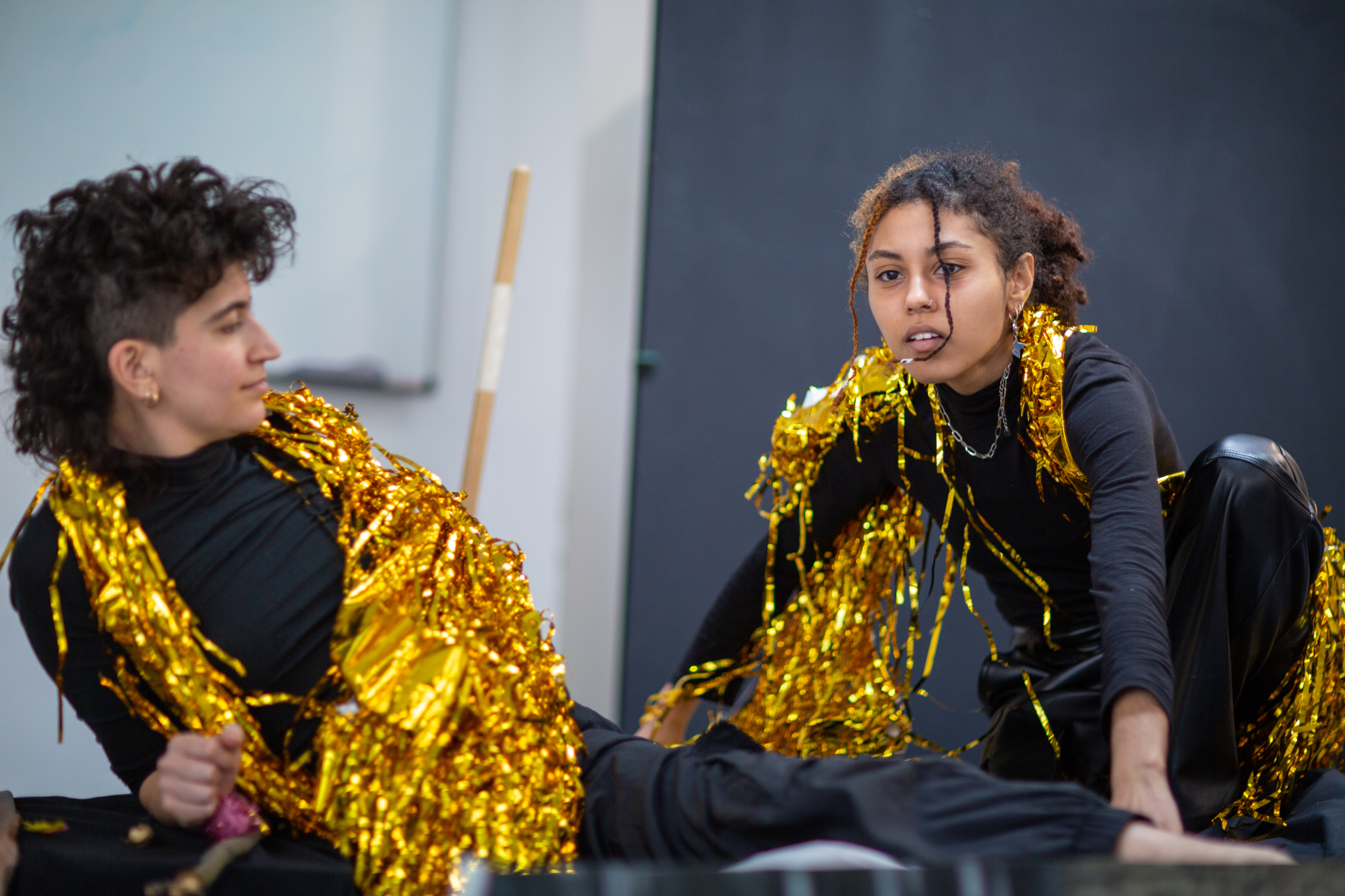
Photo of Nuke Lagranje (right) at Queens Theatre Hornchurch with Yael Elisheva by Hannah Davis.

Tell us about yourself and your creative practice.

My name is Nuke. I direct, write plays and prose and act now and then. My focus when I write or direct is usually magical realism, social activism and psychology. I produced, wrote and directed Constant Reprises. I am Spanish-Dominican, I grew up in Madrid, moved to England for university then moved to London after graduating from Portsmouth. I am queer, Black-Caribbean and… I love dogs. 

What does ‘dysbiosis’ mean to you?

Artist Spotlight: Shakira Stellar

For our seventh DYSBIOSIS artist spotlight we turn to the exciting, socially engaged work of multidisciplinary musician, composer, theatremaker and poet Shakira Stellar. In the first DYSBIOSIS R&D, Shakira crafted an ambient soundscape using lichen as a musical score, imitating its structures and textures using a synthesiser. During the second R&D, Shakira delved deeper into the symbiosis between the drummer and the earth, treating music as a dialogue of vibrations and frequencies. Through this exploration, Shakira sought to subvert the ancient notion of the “Great Chain of Being,” reimagining rocks and minerals not as the lowest, but as vital, resonant voices in the cosmic symphony.


Tell us about yourself and your creative practice

I’m a multidisciplinary artist, primarily working as a drummer and composer, but I’m also a poet and theatremaker. I fuse these mediums and approaches all the time and love doing so. I follow what sparks my interest and love to try new things so my practice is always developing and growing, which leads me to meet and work with new people, which is so wonderful. I love to learn new things, I’m so happy when I am, so who knows where my artistry will go!

How does your heritage influence the way you view/value nature? 

Artist Spotlight: Paul Burgess

This month’s spotlight is on DYSBIOSIS designer-director and director of Daedalus Theatre Company Paul Burgess, who conceived the project back in 2020 before recruiting a team of creative practitioners last year to delve deeper into social constructions of Nature using a queer and interdisciplinary lens.

Tell us about yourself and your creative practice.

I’m a set and costume designer by training and self-taught in video and interactive digital, which I use in both performance and visual art contexts. I teach on the side, mainly English as a second language, at my partner’s tutorial school, Angkriz, though I’ve also taught on theatre and theatre design courses at various universities. Both feed my creative practice by challenging me in different ways. I also have various voluntary roles, mainly in the area of sustainability. These also feed into my creative work, and include being the coordinator of the Society of British Theatre Designers’s working group on sustainability and a co-director of Ecostage. I’m also on the Environmental Responsibility Subcommittee at Queens Theatre, Hornchurch, where we’re working on DYSBIOSIS. For fun, I play the violin, most often with The Black Smock Band, which connects with the music and storytelling we do as part of our EAST project. It all adds up to one interconnected creative practice.

What does ‘dysbiosis’ mean to you?

I suggested this as a working title for the project, and it seems to have stuck, so I suppose I need to explain myself!

It came initially from I Contain Multitudes: The Microbes Within Us and a Grander View of Life by Ed Yong. Having defined dysbiosis as ‘breakdowns in communication between different species – host and symbiont – that live together, ‘ Yong goes on to say: 

Our planet has entered the Anthropocene – a new geological epoch when humanity’s influence is causing global climate change, the loss of wild species, and a drastic decline in the richness of life. Microbes are not exempt. On coral reefs or in human guts, we are disrupting the relationships between microbes and their hosts, often pulling apart species that have been together for millions of years.

I had already been thinking about the way we use Nature to talk about society, often in ways that are divorced from the reality of the natural world,  such as the notion of the body politic, or economic competitiveness being described as Darwinian, or the absurd claim that LGBTQ+ people are unnatural. But what if the metaphorical body politic is suffering from metaphorical dysbiosis?

Artist Spotlight: Fran Olivares

Our latest Dysbiosis team spotlight is on Chilean performer, director, translator, tutor and theatremaker Fran Olivares. When Fran isn’t busy bringing thought-provoking theatre to life, she is also a proud mother to a 2-year-old who keeps her on her toes and gives her a whole new appreciation for the power of imagination and play!


Tell us about yourself and your creative practice.

I’m Fran, a theatre person from Chile, now based in SE London. My work spans directing, performing, translating, writing, and facilitating, all focused on themes around identity, marginality, and the female experience. Dysbiosis addresses the urgent and dreadful impacts of global warming and neo-capitalist exploitation. Personally, these issues are not abstract for me; they’re part of the reality currently affecting South America, and as a mother, the future of our planet weighs heavily on my mind.

I’m driven by the belief that making even a small difference in our corners of the world can lead to a brighter future. So, for me, my work is more than just putting on a show for entertainment; it’s also about using my body/voice as a tool for communication, a way to build community, and a platform to shine a light on the issues that matter.

What does ‘dysbiosis’ mean to you?

To me, ‘dysbiosis’ is about imbalance, and not just in nature, but in how we interact within our communities. It’s as if everything from the ecosystems to our social structures have fallen out of harmony because of the way we treat each other and our planet. 

Artist Spotlight: Zia Álmos Joshua

Our fourth artist spotlight is on Zia Álmos Joshua [X] (neutral pronouns) who has a unique position on the Dysbiosis project as the only member of the team who has joined remotely for both R&D weeks. Currently doing their PhD in Texas, Zia has been our academic consultant and human encyclopedia on the project.

Can you give us a quick intro to yourself, your research and your creative practice?

I am a researcher, educator, writer, performer, and activ-ish, born and raised in Brixton, London, UK, currently studying for a PhD at Rice University, in Houston, Tx, USA. My research is focused on posthumanism, and the social, political, and philosophical dimensions of taxonomy, ecology, biology, emergent technology, and consciousness, with these also shaping my creative work (autotheory; poetry; prose; performance art). I am dedicated to teaching and education, and spent the 6 years prior to my PhD at the Linnean Society of London and Wellcome Collection, working in science communication and public engagement.

What does ‘dysbiosis’ mean to you?

Dysbiosis to my mind is a complicated term; it technically means a dysregulation in the/a microbial community (the microbiota or microbiome) of the human body, one that we ordinarily live in a mutualistic-symbiotic relationship with, but for whatever reason is out of wack, and so the health of the body is compromised. How I like to think about it, is imagining the Earth and its ecosystems as kinds of bodies with well-regulated mutualistic-symbiotic relationships, and that we are presently entering a stage of existence where a lot of human-related activities and processes have pushed the boundaries of what those various bodily entanglements can tolerate, and the planet itself, or various parts of it, are entering into dysbiosis, ecosystems out of wack, spiraling out of balance.

Artist Spotlight: Yael Elisheva

We met up with the Dysbiosis team again for a second week of R&D at Queens Theatre Hornchurch two weeks ago. Our third spotlight is on theatremaker, physical performer, drag artist, drama facilitator and many more things Yael Elisheva. They often work in Jewish spaces and use their artistic practice as a means of examining Jewish culture and religion.

What is your relationship with nature?

In my work, I play with found objects and explore how they can be used unconventionally and with multiple purposes. I grew up observing the sabbath, which gave me a strong connection to nature and rest and play. In today’s Western society – our relationship with rest is often viewed as lazy. I’d love to challenge that and offer rest as a means of rejuvenation for our planet.

How do queerness and nature intersect?

When I first heard of different animals and plants that are constantly changing genders like oysters and mushrooms, I felt so validated in my own gender expression. 

How does your heritage influence the way you view/value nature?

As a jew, I have rituals and prayers that revolve around nature and gratitude for nature. I have been specifically interested in how the Jewish sabbath embodies an attitude of rest which allows nature to rest as well. 

Were any aspects of the project new to you (e.g. devising collaboratively, doing an R&D, working with a designer-led company) and if so, what did you expect coming in?

Artist Spotlight: Tasnim Siddiqa Amin

Tell us about yourself and your creative practice.

I’m Tasnim, a queer Bangladeshi-British woman from East London and I am a visual artist, theatremaker and writer. I am Assistant Producer/Director for Daedalus Theatre Company. 

What does queer ecology mean to you?

I don’t do very well with long words haha but after spending a week unpacking and consistent Googling I would say queer ecology describes a critical, intersectional and decentralised approach in the way we look at how people, plants, animals and smaller organisms interact with their environment, both locally and globally.

What did you discover about yourself and the way you work during the Dysbiosis R&D week?

I discovered that I really thrive in pressured creative environments bouncing ideas of creatives from different disciplines. It dawned on me that to pursue a project you don’t need to have it all figured out, having an idea is good enough. I never knew I could work with venues this way, the way Paul was doing, to say hey I have an idea and I want to bring along a bunch of people that I’ve never met from different creative disciplines in a rehearsal room at your theatre and see what happens.