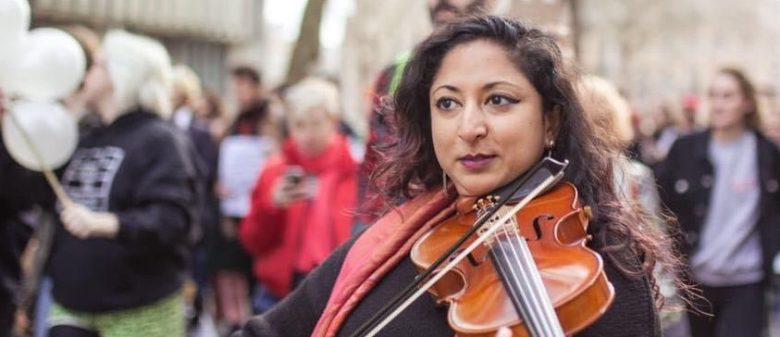
Queer musician, activist and academic Maya Bhardwaj joined the Black Smock Band for our Queer Revolutionary Singalong earlier this year. Growing up in the US, the songs she shared with the audience came from the Black American struggle. Read on to learn more about Maya’s incredible life, music and activism around the world before settling in East London, where you might find her teaching songs at protests.
Tell us about yourself and your creative practice.
I’ve been lucky to play the violin since I was 4 years old. This was thanks in large part to my mother, who put me into lessons where we were living at the time, the Appalachians in Virginia, also known as the home of bluegrass, a working-class music style forged through the meeting between Irish and English workers and Black African enslaved folks, where the fiddle plays a huge role. I trained in Western Classical but learned stylistic elements from bluegrass, and was also steeped in jazz and the Blues when we moved to Detroit, where I spent most of my youth. I also sang from a young age, casually and later slightly less casually, in choirs and musical theatre. I burned out on Western Classical education early, though, as I found the focus on endless hours of rehearsal, hyper-competition, and emphasis on perfecting exactly what was on the page to be overly dogmatic and stifling. My early music educators were amazing, though!
I gave up the violin for some years while in university, and came back to it really after meeting an amazing violinist in Cuba who was the frontwoman of an incredible Cuban jazz band, who encouraged me to re-learn in an improvisational style. I worked with an amazing improvisational coach and bluegrass and jazz violinist in New York while I lived there, who really re-built my comfort in feeling into the music and going with the flow in a collective way. I also worked briefly with two amazing Carnatic violinists in New York as well, and then studied closely with Celtic violinists and Cuban jazz musicians in the UK, Mariachi and Son Jarocho musicians in Mexico, South African jazz and maskandi musicians while I lived in Johannesburg, and some incredible Bangla musicians while I lived in Dhaka. Like my life, my creative practice has been all about picking up the influences of the diverse cultural spaces in which I’ve been privileged to live, figuring what works for me, and building a bit of an eclectic soup.