Tag Archives: storytelling

Associate Artist Spotlight: Sef Townsend

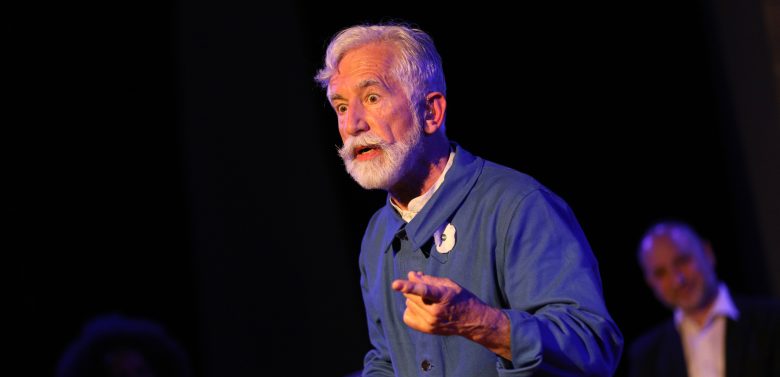
Our second East spotlight is on global storyteller, interfaith peace advocate and Londoner Sef Townsend, who is of mixed Jewish and traveller heritage. Sef co-founded the East Storytelling Project alongside Paul Burgess and Shamim Azad back in 2014. Tasnim Siddiqa Amin had a chat with Sef one Saturday afternoon about his 30-year career in storytelling, his love for the East End and his latest creative projects. 

Listen to the interview here:


Tell us about yourself 

I’m a storyteller. I’ve been telling stories for a long time. But what are the contexts that I tell? So, I go regularly to schools, and I work with children from really young until they’re really quite old, actually. I’m also involved in peace and reconciliation work. And I’ve worked in Israel and Palestine, Armenia, Azerbaijan, South Africa, areas of conflict or post-conflict. I have been brought in to try and create some conversations between people who, according to their background, are supposed to dislike each other.

I’ve worked in Northern Ireland [where] I lost my hearing in a bomb blast many years ago. This led me to my involvement in the peace process. And from there we went to South Africa to a particular post-apartheid setup where people who’d been involved in the conflict in Northern Ireland, either as combatants or as people who’d suffered by being bereaved or having, for example, lost a leg or lost their hearing or being affected by the conflict, shared our experiences with people who had been, and were still, affected by the conflict and divisions in South Africa, and they shared their experiences and memories and legacy of apartheid. We all benefitted so much. It was a way of people learning through sharing stories. 

I’m very involved in intercultural activities, as I am with East. I do a lot of work with young asylum seekers and refugees from all over the world, mainly from conflict zones. From Eritrea, Sudan, Afghanistan, Iraq, Iran. People come from conflict zones and have to very quickly settle into life here in the UK. It’s a very delicate work because you’re dealing with trauma. So all these things are the background to my stories. I use stories in all these different contexts, and I’ve been doing it now for 30 years.

What is your relationship with East London?

Well, because I’m of the same heritage [as] people who arrive in East London.

I arrived in London in 1980, so that’s 45 years. Before then, I lived in various places. I lived in New Zealand for many years. I’m a New Zealand citizen. I lived in the Netherlands as a young person. I lived in Sudan. So I had a background that connects with the world. And when I arrived in London, I would live in places like the East End. London Fields. I lived there. And I’ve been connected with the East End of London. Now I’m in Southeast London. I still consider that East London, but it’s on the other side of the river. 

And listening to lots of stories about young Jewish men who would live in the East End of London, they’d often go across the river, across Tower Bridge, they wanted a different view on the world. And so they go across Tower Bridge, and they go to Southeast London, which is where I live now. It was different. You know, there weren’t so many Jewish people there. It just gave them a feeling of another world.

And so my relationship with East London is visiting many worlds. We meet people who come from various backgrounds. I’m often in Whitechapel. I love the Whitechapel market. I go to the Whitechapel Gallery. It’s very mixed around the Aldgate area. You know, you go to a trendy cafe, and Bangladeshi people are serving there. You go into Whitechapel High Street, people with their family are buying things that they need. It’s a vibrant, lovely area. I suppose it’s a relationship of loving it.

Could you share with me your journey with the East Storytelling Project? I understand that you are one of the co-founders.

Paul Burgess and Shamim Azad already had done a few projects. I was invited along just to show what I could do. And then we thought, well, it’s time to create something which celebrates people in the East End of London. People would come together and share. A person who had Jewish roots in Brick Lane would come and tell their story of their parents arriving in the East End and they would share it with people from a Bangladeshi background. There were some real insights. People were surprised at the similarities. The great mosque in Brick Lane, before it was a mosque, it was a synagogue. Before it was a synagogue, it was a church. And it was the real history of what had happened over the years in this part of the East End of London, a place of immigrants.

We wanted to share our stories, our parents’ stories, not just of their journey, but sometimes their folktales, stories they’d heard. And it came to the point after about a year of workshopping that people were expressing that they’d like to perform.

I was very involved in creating the workshops. I had this storytelling background which enabled me to take us through various exercises. Shamim and I got on very well as storytellers. We sort of spark off each other. Paul with his musicality. So we started creating performances.

We performed initially at Rich Mix and at the Brady Centre. And then I had an idea that after all the performances, that was it, and I thought we need to use these and make an archive. We can’t just have these stories disappearing. Let’s record them. And that’s how the East Archive started.

It’s now got stories from about 25 storytellers from almost as many countries. I mean, in addition to Bangladeshi, Somali, Jewish, we’ve got Korean. We’ve got Swedish. We’ve got Vietnamese. And there it is on the eastarchive.com. And it’s well worth seeing because there’s a real treasure there.

Could you share with us a favourite East memory?

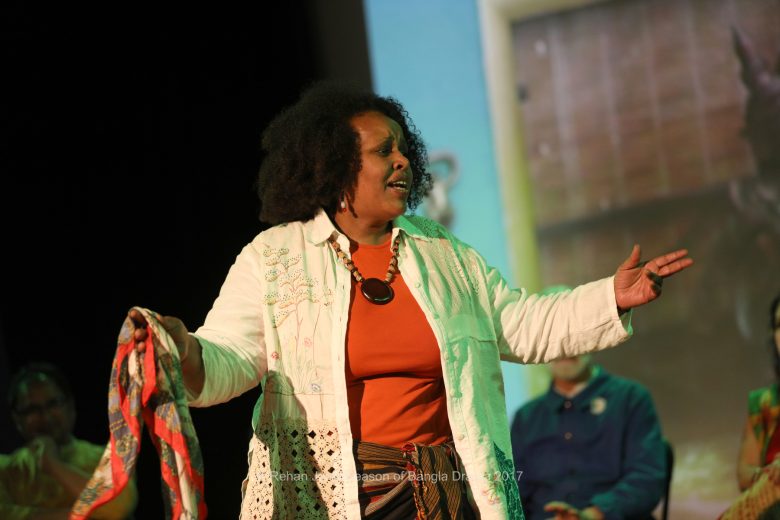
The latest thing that we did, there wasn’t much funding, but we all wanted to do this thing. And so I think we had one meetup and one rehearsal. But I’d worked with Kauthar, who is from a Somali background. I’d worked in lockdown in sort of mentoring her into telling. And she’s a really vibrant, energetic storyteller. And I think you had brought along Marshall with his particular Bangla, queer, political; he’s very English as well as being very Bangladeshi. We had John Heyderman, who’s a great storyteller. I was the first to mentor him and I continue to be his mentor. And then we had Farah and some other tellers. There was Shamim, but myself, I was the one who was hosting. Paul was playing the violin. You were there encouraging people to come along and tell on the day. It was a very vibrant, energetic thing. With only one rehearsal, it was very good.

What are you currently excited about creatively? 

Well, I’m currently excited about a book that I’m working on, which is Wild London Tales for Children. I’m co-author of two books with Anne Johnson. One is London Folk Tales for Children. The other is London River Tales for Children. But now the publisher wants us to do another book. And I’ve decided on Wild London Tales for Children. So that’s a creative process. It’s not easy writing. It’s not easy writing with somebody else. But it’ll be out there, I hope, this time next year. 

In the last year, I’ve been to seven different countries, mainly in the Middle East and North Africa. I’ve got a project in Tunisia coming up in May. I was there recently doing a language course because I know Arabic, but I wanted to improve it so I could tell. So I’ll be there for the festival in May. 

Although at my very old age, I was 78 in April, I sometimes think I should quiet down a bit. But I can’t resist people asking me things. I’m still regularly in schools still, and I do these different things. So as long as I can, I will.

Follow Sef Townsend on Instagram.
Artist Spotlight: Marshall Savage

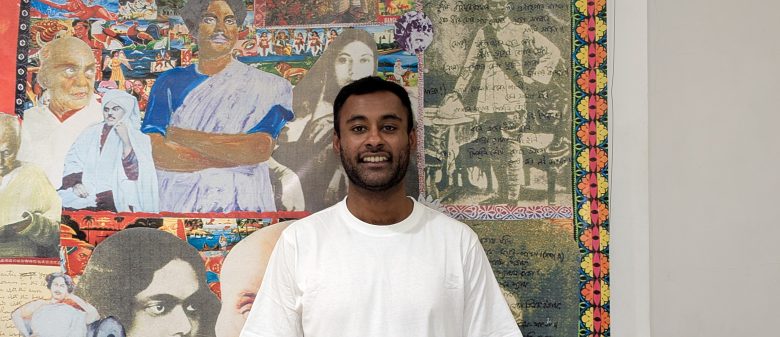
Photo of Marshall Savage at Kobi Nazrul Centre (2025)

Marshall Savage, also known as Mijan, is a Bangladeshi-British queer person from Bow. Marshall is passionate about LGBTQ+ rights and welfare not warfare. Marshall doesn’t come from a creative or academic background, but he loves learning new skills and embracing new experiences wherever they lead him. He is the newest member of our East Storytelling Project. 

After a late evening of rehearsals for our latest East production EAST TO ELSEWHERE, local trade unionist Marshall and assistant producer Tasnim sat at Chaiwalla on Brick Lane with a coffee and roti to talk about the East End, activism and the importance of sharing stories of migrant women. 


Tell us about yourself.

My name is Marshall, I’m born and raised in Tower Hamlets, in Bow specifically. I work for Tower Hamlets and I’m also a Trade unionist. I’m very heavily involved in activism, especially local activism and organising against the far right 

Fun fact?

I am obsessed with vampires.

What makes the East End such a rich source of stories? 

The East End is an amazing place; it was always seen as the armpit of London, where all the immigrants were shoved that no one wanted to deal with, from the Jews to the Irish to now the Bengalis. We have this incredible knack of creating a community wherever we are. Now Tower Hamlets and the East End are probably the most diverse cultural places in London, if not the world. 

And how does your specific heritage influence the way you see the East End?

The way my parents migrated into this country and the struggles they faced, and me being an immigrant and queer, made me realise what it means to fight for equality, to fight for what’s right and look into the intersection of what it means to be a brown queer person. 

What is storytelling? 

Storytelling is sharing really important parts of your life, it doesn’t have to be word to word, it doesn’t have to be fact by fact, it’s how we interpret how we experience life. It matters because it’s the best way to share information, look at history, travellers, they are the best way to tell stories, how we connect with people, how we get people from different places to understand each other. 

Why is it important to tell your mum’s story?

I feel like a lot of women of colour came here slightly unheard. My mum came here without any connections, she had to build her own community and that is a story worth telling, it is the story of many mothers and many women who came not just to London or England but who migrated to other parts of the country or other parts of the world, who stuck out and didn’t have a voice for themselves. 

What has been your experience of the East Storytelling Project so far?

I walked in there not knowing what to expect. I thought I’d see more brown faces. 2 Jewish men, a beautiful black woman, 2 beautiful brown women, I saw people from different lives and experiences all encapsulating what the East End is. 

Recommendation of a book that relates to East London?

One of the books I am reading right now is called United Queerdom by Dan Glass, who was a HIV activist and East End local. It talks about the East End struggle, the queer struggle and ongoing battles to fight for equality. 

Call for Emerging Bengali Storytellers: East to Elsewhere on the theme of KINDNESS

Photo by Rehan Jamil


Do you have a story to tell about kindness? We’re looking for Bengali storytellers from Tower Hamlets. If you have a story about acts of kindness, migration or how Tower Hamlets has shaped your life, we want to hear from you! This callout is for people with little or no professional experience in storytelling.

About the Project: We’re thrilled to announce East to Elsewhere, a new storytelling event celebrating the theme of Kindness from the EAST Project. This project will explore the rich history and diverse cultures of Tower Hamlets through stories of migration, community support, and kindness—especially stories of kindness shown by migrant communities to newcomers such as refugees and asylum seekers.

The kind of thing that we are looking for:

  • Stories about acts of kindness within migrant communities in Tower Hamlets.
  • Experiences of newcomers, especially refugees and asylum seekers.
  • Historical migration stories linked to East London.
  • Contemporary stories about migration today.
  • Personal stories – if you feel like sharing!
  • Stories that reflect the awesome diversity of East London and Tower Hamlets.

Eligibility:

Are you Bengali?

Do you have a connection to Tower Hamlets?

Are you interested in telling stories?

Are you new to storytelling?

If you answered yes to any of these questions, and are NOT a professional storyteller, we invite you to pitch your story!

Key Details:

Fee: £175 

Apply (by email):

Send a max 250-word pitch by email, including: your name, phone number, and your connection to Tower Hamlets. Email us here.

If your story pitch is successful, we’ll give you a call to tell us about yourself and why you selected your story.

There will also be an open mic on the night of the performance. Everyone is welcome to share a story or try some new material with us on the night! Traditional storytelling, a real-life story, spoken word… as long as it’s narrative, and relates to the theme of kindness. Sign-up in person on the night.

Event Date: Friday 14th November 2025, 7.30PM as part of A Season of Bangla Drama. Tickets can be booked here.

Call for Storytellers: Tales of Tower Hamlets on the theme of KINDNESS

Do you have a story to tell about kindness in Tower Hamlets? We’re looking for storytellers with Caribbean, Somali, or/and West African heritage. If you have a story about acts of kindness, migration, or how Tower Hamlets has shaped your life, we want to hear from you!


About the Project: We’re thrilled to announce Tales of Tower Hamlets, a new storytelling event celebrating the theme of Kindness from the EAST Project. This project will explore the rich history and diverse cultures of Tower Hamlets through stories of migration, community support, and kindness—especially stories of kindness shown by migrant communities to newcomers such as refugees and asylum seekers.

What We’re Looking For:

  • Stories about acts of kindness within migrant communities in Tower Hamlets.
  • Experiences of newcomers, especially refugees and asylum seekers.
  • Historical migration stories linked to East London.
  • Contemporary stories about migration today.
  • Personal stories—if you feel like sharing!
  • Stories that reflect the awesome diversity of East London and Tower Hamlets.

Eligibility:

Mud Stories at the Rum Factory

We’ll be at The Old Rum Factory Festival, at Bow Arts’s Wapping studios, this Saturday, 17th August, with Mud Stories – a performance of stories and music from banks of the Thames.

Come down to the River Thames at low tide and join the mudlarks’ hunt for some very valuable objects that will tell us something unique about London’s history. But there is so much here, how do we know where to look? All we can see are mud, shells, stones, and rubbish! Maybe we can ask someone for help? Who’s this?

Here to guide us are East lead artists Shamim Azad and Sef Townsend, Daedalus assistant producer/director Tasnim Siddiqa Amin and Daedalus director/musician Paul Burgess.

Suitable for all ages but recommended ages 8+, it can be seen at 2pm and 4pm. And it’s free!

The Old Rum Factory Festival is centred on open studios, so you can see the work of the many incredible artists who are based there. But there’s lots else to see as well, including a whole programme of workshops. You can get all the details here.

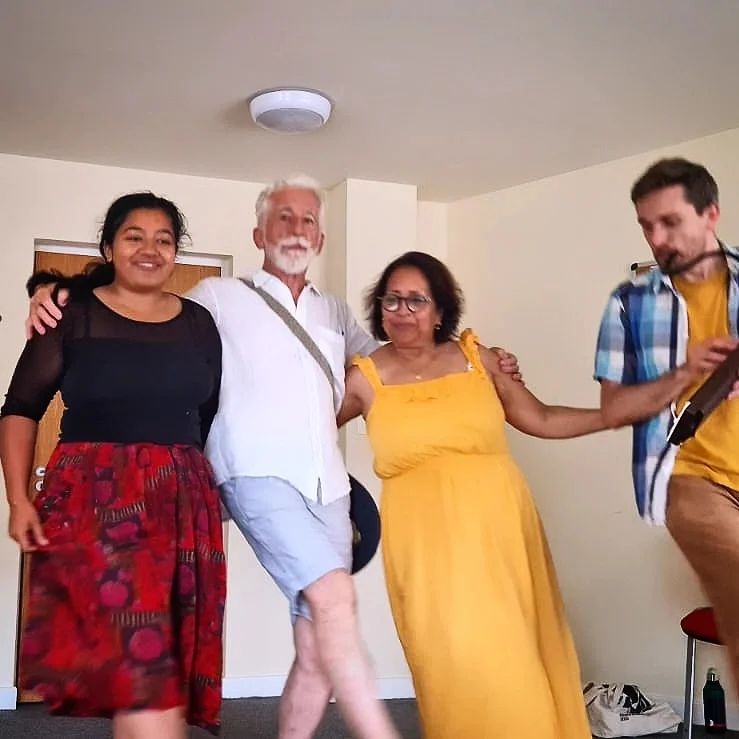
We’ll leave you with a snap from rehearsals. Hope to see you there!

Ten Years East: a huge thank you!

Massive thanks to our wonderfully supportive audience, to Ruksana Begum and all at A Season at Bangla Drama, to Jack Birch, John Anthony and the rest of the Rich Mix Team, to Maeve O’Neill at Rua Arts, to our sponsors and funders, and of course to all our incredible artists.

The show was filmed by Marble Sinew and photographed by A Season of Bangla Drama regular Rehan Jamil. But first, let us share the wonderful reel made by Nabeela Zaman:

Next, the official pics from Rehan:

Here’s the video of the show, filmed and edited by Marble Sinew:

Finally, some photos by Jonathan Chan and Kanatip Soonthornrak, and a picture, again by Rehan, of Shamim and Paul being presented with an award for being part of the 20th year of A Season of Bangla Drama.

Announcing the lineup for Ten Years East!

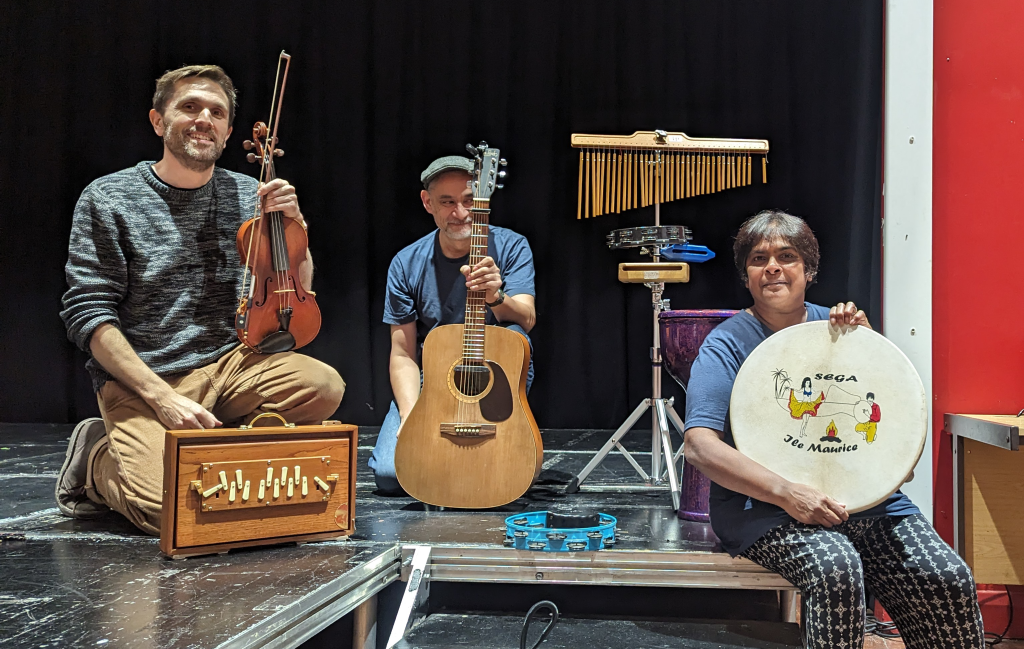
Paul Burgess, Andy Bannister and Michele Chowrimootoo. Image credit: Tasnim Siddiqa Amin

As part of A Season of Bangla Drama, Sunday 19th November 2023, 5:30PM we return to the iconic East London venue Rich Mix, where the East storytelling started in December 2013.

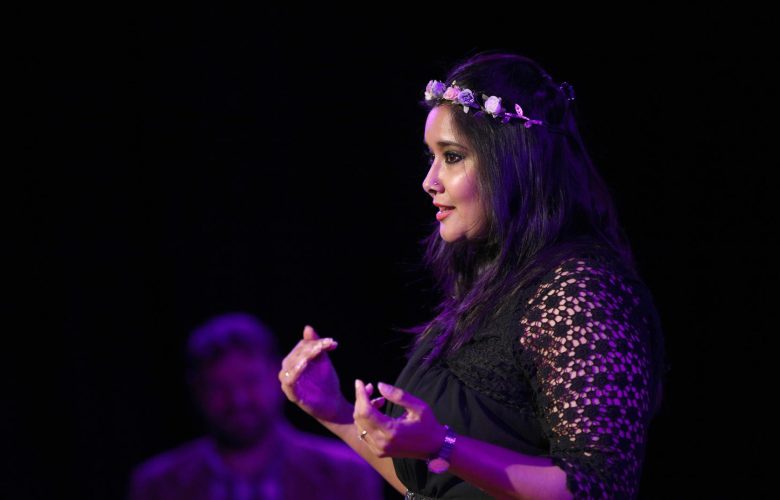
We have an exciting evening of stories and live music for you, and are thrilled to announce the incredible talent that will be taking the stage this Sunday. Farah Naz makes a return to EAST with the story of ‘The Queen of Sheba and Solomon’, we will hear the tale of ‘Rochael the Gossip’ from John Heyderman, Andy Bannister of The Black Smock Band singing ‘The Water is Wide’ and a reimagining of ‘The Sultana’s Dream’ from EAST newcomer Tasnim Siddiqa Amin. We’re also joined by musician and singer Hasan Ahmed and percussionist Michele Chowrimootoo.

Daedalus November Newsletter

Dear friends,

Welcome to our November newsletter.

Image credit: montage by Paul Burgess using photos by Simon Daw and Rehan Jamil

Ten Years East

With A Season of Bangla Drama nearing its halfway point, and our next show, Ten Years East, just over a week away, we’d like to tell you more about the exciting line-up we have brought together for you.

Farah Naz is a poet and Deputy Director of The British Bilingual Poetry Collective. She was part of the original East group, and some of her stories can be seen on our East Archive, as can John Heyderman’s remarkable story of his father’s escape from Nazi Germany: Two Gold Rings. John will be sharing a Jewish story, and Farah will tell a tale from the Muslim tradition.

Our two lead storytellers, both of whom have been at the heart of the East project since the start, will also be performing. Shamim Azad is a highly celebrated writer, poet and storyteller here in East London and in Bangladesh, while Sef Townsend, an internationally acclaimed storyteller, has told stories around the world, from refugee camps to festivals. They will be joined by Tasnim Siddiqa Amin, Daedalus’s assistant director and producer. Tasnim is a theatremaker, critic and artist, and has a script-reading of one of her own plays later today as part of the festival programme: Knotted.

Daedalus October Newsletter

Dear friends,

Welcome to our October newsletter.

Ten Years East – tickets now on sale!

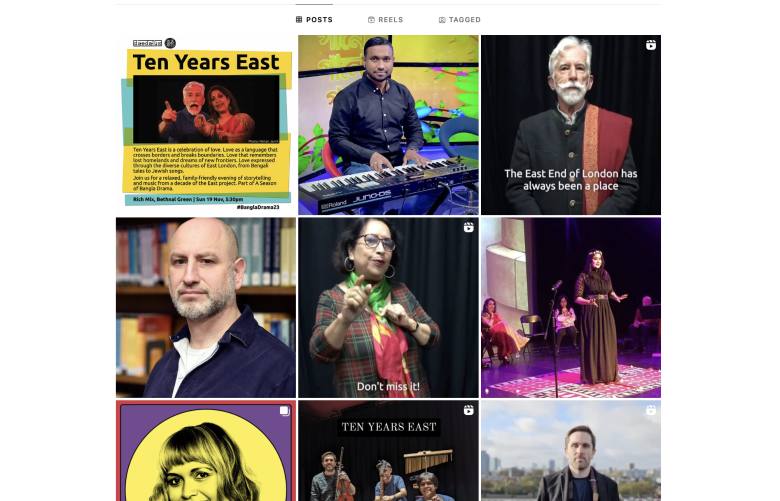
Join us for a relaxed evening of compelling stories and unforgettable songs from across the diverse cultures of East London.

Ten Years East is a celebration of love as a language that crosses borders and breaks boundaries, that remembers lost homelands and dreams of new frontiers. After a decade of performances, workshops and gatherings, the East storytelling project now presents an exciting lineup of musicians and storytellers in this family-friendly event.

With material spanning the globe to reflect the rich cultures of our East End, from English folklore to Bengali tales and Jewish songs, you are warmly welcomed to celebrate Ten Years East.