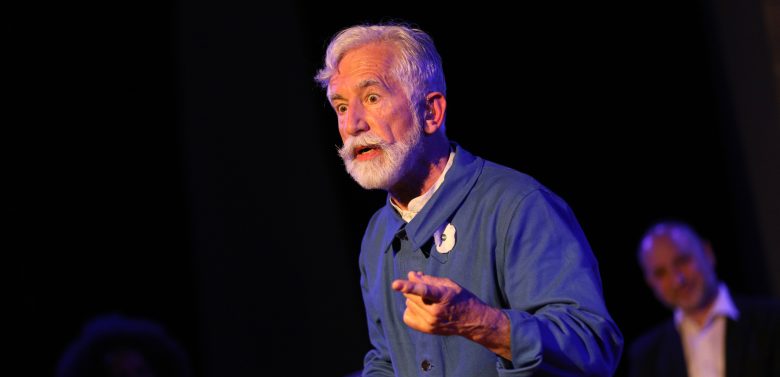
Photo of Sef Townsend at A Season of Bangla Drama by Rehan Jamil (2017)
Our second East spotlight is on global storyteller, interfaith peace advocate and Londoner Sef Townsend, who is of mixed Jewish and traveller heritage. Sef co-founded the East Storytelling Project alongside Paul Burgess and Shamim Azad back in 2014. Tasnim Siddiqa Amin had a chat with Sef one Saturday afternoon about his 30-year career in storytelling, his love for the East End and his latest creative projects.
Listen to the interview here:
Tell us about yourself
I’m a storyteller. I’ve been telling stories for a long time. But what are the contexts that I tell? So, I go regularly to schools, and I work with children from really young until they’re really quite old, actually. I’m also involved in peace and reconciliation work. And I’ve worked in Israel and Palestine, Armenia, Azerbaijan, South Africa, areas of conflict or post-conflict. I have been brought in to try and create some conversations between people who, according to their background, are supposed to dislike each other.
I’ve worked in Northern Ireland [where] I lost my hearing in a bomb blast many years ago. This led me to my involvement in the peace process. And from there we went to South Africa to a particular post-apartheid setup where people who’d been involved in the conflict in Northern Ireland, either as combatants or as people who’d suffered by being bereaved or having, for example, lost a leg or lost their hearing or being affected by the conflict, shared our experiences with people who had been, and were still, affected by the conflict and divisions in South Africa, and they shared their experiences and memories and legacy of apartheid. We all benefitted so much. It was a way of people learning through sharing stories.
I’m very involved in intercultural activities, as I am with East. I do a lot of work with young asylum seekers and refugees from all over the world, mainly from conflict zones. From Eritrea, Sudan, Afghanistan, Iraq, Iran. People come from conflict zones and have to very quickly settle into life here in the UK. It’s a very delicate work because you’re dealing with trauma. So all these things are the background to my stories. I use stories in all these different contexts, and I’ve been doing it now for 30 years.
What is your relationship with East London?
Well, because I’m of the same heritage [as] people who arrive in East London.
I arrived in London in 1980, so that’s 45 years. Before then, I lived in various places. I lived in New Zealand for many years. I’m a New Zealand citizen. I lived in the Netherlands as a young person. I lived in Sudan. So I had a background that connects with the world. And when I arrived in London, I would live in places like the East End. London Fields. I lived there. And I’ve been connected with the East End of London. Now I’m in Southeast London. I still consider that East London, but it’s on the other side of the river.
And listening to lots of stories about young Jewish men who would live in the East End of London, they’d often go across the river, across Tower Bridge, they wanted a different view on the world. And so they go across Tower Bridge, and they go to Southeast London, which is where I live now. It was different. You know, there weren’t so many Jewish people there. It just gave them a feeling of another world.
And so my relationship with East London is visiting many worlds. We meet people who come from various backgrounds. I’m often in Whitechapel. I love the Whitechapel market. I go to the Whitechapel Gallery. It’s very mixed around the Aldgate area. You know, you go to a trendy cafe, and Bangladeshi people are serving there. You go into Whitechapel High Street, people with their family are buying things that they need. It’s a vibrant, lovely area. I suppose it’s a relationship of loving it.
Could you share with me your journey with the East Storytelling Project? I understand that you are one of the co-founders.
Paul Burgess and Shamim Azad already had done a few projects. I was invited along just to show what I could do. And then we thought, well, it’s time to create something which celebrates people in the East End of London. People would come together and share. A person who had Jewish roots in Brick Lane would come and tell their story of their parents arriving in the East End and they would share it with people from a Bangladeshi background. There were some real insights. People were surprised at the similarities. The great mosque in Brick Lane, before it was a mosque, it was a synagogue. Before it was a synagogue, it was a church. And it was the real history of what had happened over the years in this part of the East End of London, a place of immigrants.
We wanted to share our stories, our parents’ stories, not just of their journey, but sometimes their folktales, stories they’d heard. And it came to the point after about a year of workshopping that people were expressing that they’d like to perform.
I was very involved in creating the workshops. I had this storytelling background which enabled me to take us through various exercises. Shamim and I got on very well as storytellers. We sort of spark off each other. Paul with his musicality. So we started creating performances.
We performed initially at Rich Mix and at the Brady Centre. And then I had an idea that after all the performances, that was it, and I thought we need to use these and make an archive. We can’t just have these stories disappearing. Let’s record them. And that’s how the East Archive started.
It’s now got stories from about 25 storytellers from almost as many countries. I mean, in addition to Bangladeshi, Somali, Jewish, we’ve got Korean. We’ve got Swedish. We’ve got Vietnamese. And there it is on the eastarchive.com. And it’s well worth seeing because there’s a real treasure there.
Could you share with us a favourite East memory?
The latest thing that we did, there wasn’t much funding, but we all wanted to do this thing. And so I think we had one meetup and one rehearsal. But I’d worked with Kauthar, who is from a Somali background. I’d worked in lockdown in sort of mentoring her into telling. And she’s a really vibrant, energetic storyteller. And I think you had brought along Marshall with his particular Bangla, queer, political; he’s very English as well as being very Bangladeshi. We had John Heyderman, who’s a great storyteller. I was the first to mentor him and I continue to be his mentor. And then we had Farah and some other tellers. There was Shamim, but myself, I was the one who was hosting. Paul was playing the violin. You were there encouraging people to come along and tell on the day. It was a very vibrant, energetic thing. With only one rehearsal, it was very good.
What are you currently excited about creatively?
Well, I’m currently excited about a book that I’m working on, which is Wild London Tales for Children. I’m co-author of two books with Anne Johnson. One is London Folk Tales for Children. The other is London River Tales for Children. But now the publisher wants us to do another book. And I’ve decided on Wild London Tales for Children. So that’s a creative process. It’s not easy writing. It’s not easy writing with somebody else. But it’ll be out there, I hope, this time next year.
In the last year, I’ve been to seven different countries, mainly in the Middle East and North Africa. I’ve got a project in Tunisia coming up in May. I was there recently doing a language course because I know Arabic, but I wanted to improve it so I could tell. So I’ll be there for the festival in May.
Although at my very old age, I was 78 in April, I sometimes think I should quiet down a bit. But I can’t resist people asking me things. I’m still regularly in schools still, and I do these different things. So as long as I can, I will.
Follow Sef Townsend on Instagram.