Partners and Collaborators

Artist Spotlight: The Black Smock Band


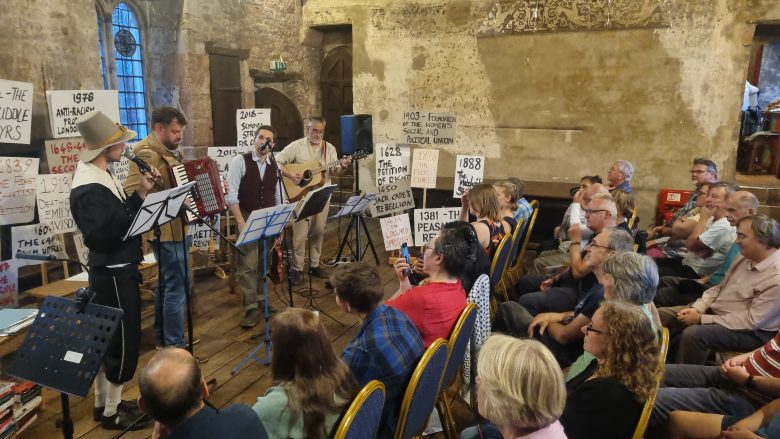
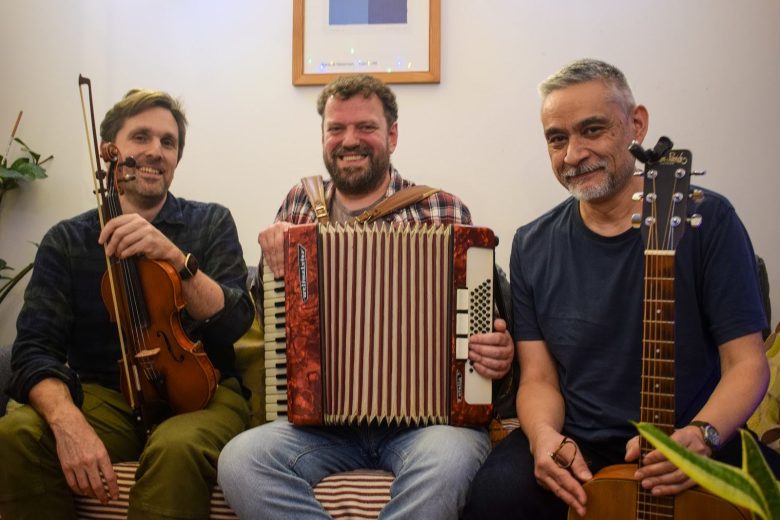
Daedalus Theatre Company and the Black Smock Band have worked together on many projects. You may recognise our director, Paul Burgess, as one of the members of the band! After years of collaborations, we think it’s time to spotlight the band in their own right. Grab a cuppa and settle in because it’s a read as heart-warming as the band’s music, which incidentally, you can hear live – and sing along with – on Wednesday 22nd April 2026 at Camden People’s Theatre. Book your tickets for QUEER REVOLUTIONARY SINGALONG now:

Tell us about yourself and your creative practice.

Andy Bannister: In addition to being a musician, I’m a visual artist and a tutor working in higher education. I teach on a fine art course where I mainly work with students who focus on sculpture and combined media- this reflects what I do when I’m in my studio. In my current work, I’m exploring the impact of science and technology on culture and society, with a focus on the widespread civil opposition to the nuclear arms race during the Cold War period. There’s a crossover here with my activities as a musician, in terms of my interest in the role of folk music within protest movements and the emphasis on stories of resistance within the folk tradition.

Dan Cox: I’m a tour guide, writer, singer and accordionist. In all my roles, I am principally interested in telling stories. Stories can be told in all sorts of ways, including through music. Emotions connect all of us. We all feel happy, angry, sad, excited and so on, and music can tap directly into all those feelings. In everything I do, I try to reach into the human experience and convey those emotions through whichever medium I am working in.

Paul Burgess: I’m a theatre-maker and musician, with an interest in co-creative practice, ecological thinking and queerness. I trained as a theatre designer and regularly design shows, especially for Deafinitely Theatre, but have also directed devised projects for Daedalus such as Selfish, A Place at the Table and Dysbiosis. My idea of directing, however, is about creating conditions for creativity, rather than telling people what to do. Alongside this, I’m a co-director of Ecostage, the Society of British Theatre Designers’ sustainability lead, and an MSc student at the Centre for Alternative Technology.

What is the Black Smock Band?

PB: We’re South-East London’s premier gay, ecosocialist folk band… probably? That said, when we started, we were probably the UK’s only gay, ecosocialist folk band. Now, for all we know, they’re two a penny.

What is behind the name of the band?

AB: The name relates to the LGBTQ folk nights that the band grew out of. A good friend of ours (and founding member of the group, who now lives in Galicia) ran the folk nights in her flat in Vauxhall, which she used to re-name as ‘The Black Smock Inn’ on the occasions that it took place, just for the fun of it- when we decided that we were a group we needed a name so ‘The Black Smock Band’ seemed kind of logical at that point, and we’ve stuck with it.

How did you join the Black Smock Band?*

AB: Paul and Dan had known each other and played together for a while before I met them, at one of the folk nights that I turned up at – the band grew out of those sessions in quite a natural way.

DC: Back in the mists of time, I was a member of a queer walking group. One of the other members and I got chatting about folk music and they invited me to a “folk feast” at their place. I met several musicians and had a great time singing with them. We were then asked to perform at a pub a few weeks later, so realised we would have to become a band! Initially there were four of us. There have been a couple of line-up changes, but Paul, Andy and I have all been there since the start and are now the only ones left!

PB: As Andy and Dan said,  we were all going to the same queer folk nights and the band sort of accidentally formed out of that. A few of us fell into doing music together, then a local pub asked us to play. And we thought, ‘oh, we must be a band now then!’

For those who aren’t familiar, what is English folk music? Why does this musical genre speak to you?

DC: English folk music is the music of the common people of England, mostly prior to the 20th century. It was played on whatever instruments people had to hand and sung by people who worked the land or in the mines and factories that powered the Industrial Revolution. Some songs go back as far as the 13th century, but the main bulk of English folk is from the Victorian age. However, the folk tradition continues strongly and new material is being produced by a huge diversity of artists to this day.

The history of England is often told through stories of Kings and Queens and Great Deeds, but there is another story of hardship, joy, love, despair and everything in between of the common, ordinary people. Their stories weren’t often written down, but they were sung, and many of those songs are still remembered today, thanks to people who collected those songs and preserved them – like John Clare. When I sing those songs, I am helping to preserve the memories of the people of England who are usually forgotten by “history”.

Could you share with us a favourite Black Smock Band memory?

AB: Playing at St Botolph’s Church in Helpston, Oxfordshire as part of the John Clare Festival a few years ago. We had been interested in John Clare’s poetry and his activities as a song collector for a while beforehand, so it was great to play at a festival held in his honour.

DC: It’s hard to choose anything specific, but those moments of community where voices come together, and music links us together, are hard to beat.

PB: The funniest might be when, due to a double booking, we ended up playing in a pub full of football fans, who we somehow managed to convert into ardent queer folk music fans. Probably only very temporary fans, mind you. One of the most profound things for me, though, was bringing Daedalus and the band together to create Gerrard Winstanley’s True and Righteous Mobile Incitement Unit, our gig theatre piece about the history of protest.

What is queer culture?

DC: Queer culture is often depicted in the media as being a very specific, stereotypical kind of culture – what most people think of as “the scene”, but there is much more to it than that. There’s nothing wrong with being a part of that mainstream scene, of course, but it was never somewhere I felt comfortable. When I met the other guys in the band, I finally felt I had found a little home in my own comfortable corner of “Queer culture”. Queer people often grow up feeling very isolated. For me, coming from rural Suffolk, it was a very lonely experience, so to find a sense of community with like-minded queers was a fabulous, life-affirming thing. Queer culture is hard to define, but it can be life-saving for the lonely.

PB: I don’t think one can define queer culture beyond saying it’s culture created by queer people that in some way engages with queer experience. And it’s essential to create space for this in our hetronormative society. For us, though, the initial aim was not so much to do with queer culture per se but to create a space where queer people could enjoy folk music in ways that felt safe and relevant. Now, with the world as it is, it feels more important to make that queerness more up front and political.

How powerful is live music? 

AB: Playing live is really important in terms of forming a direct connection with an audience. When the mood is right, there can be a sense that people are actively listening to (and watching) what you’re doing on stage, and as a performer, you can really respond to this in the moment- so each performance is slightly different, depending on the audience and the environment you’re playing in. And it’s always great when people sing along to the words or decide to get up and dance…

DC: Live music can be incredibly powerful as a way of bringing people together in community, even if they’ve never met before. To sing and dance together is one of life’s greatest joys, and that’s how I want people to interact with us when we perform. It’s not about just getting up on a stage and singing and playing at people – it’s about coming together to sing, dance and feel the connection with one another.

PB: Before mass media, communities had to make their own entertainment. Live music was central to that, and that’s where folk music comes from. That need has never fully gone away – and in some places, like Ireland, that has continued to flourish, but for a while, I think it’s fair to say, it was pushed to the margins in England by top-down culture and mass media. A lot of the folk tradition, including much of the music, has been lost. Now, corporate media threatens to overwhelm us, to strip us of individuality, and take away our ability to tell fact from fiction, or human-made from AI. I think this means live music, and especially grassroots live music, i.e., music that is not under corporate control, suddenly seems really important again.

Can you recommend a folk song that speaks to our times?

AB: There’s a song written by John Connolly, which was recorded by the folk duo Jimmy Aldridge and Sid Goldsmith a few years ago, titled ‘The Last Ploughshare’, which is about the consequences of the exploitation of the natural world for profit throughout history. It’s a powerful contemporary folk song that directly addresses the most pressing issue of our time.

DC: A song we keep coming back to is the Diggers’ Song, written by Gerard Winstanley as his ragged band tried to build a socialist utopia in Surrey in the aftermath of the first English Civil War. They were crushed by Cromwell’s men and their dream destroyed, but their spirit lives on. In these times, their message of community and organisation against the truly horrific things that still happen in this world remains as important as ever. War, poverty and all manner of horrors still dog humankind, but there is hope as long as people can still come together to sing and join in community.


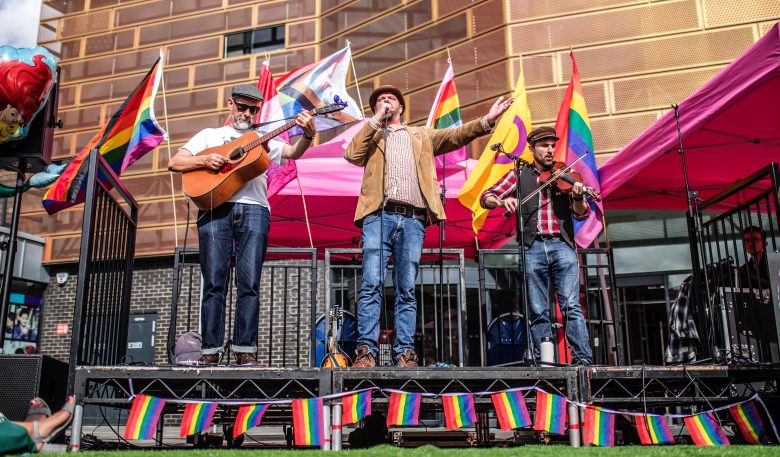
Join the band for a gig and singalong at Camden People’s Theatre on Wednesday 22nd April 2026 at the Camden People’s Theatre.

Book your tickets for QUEER REVOLUTIONARY SINGALONG here:
Daedalus returns to Camden People’s Theatre with QUEER REVOLUTIONARY SINGALONG featuring The Black Smock Band

Daedalus returns to Camden People’s Theatre 15 years after their acclaimed immersive documentary drama A Place at the Table, to present QUEER REVOLUTIONARY SINGALONG with ecosocialist folk band The Black Smock Band. 

Join us this April for fiery folk tunes and leftie singalong classics, from ‘Bread and Roses’ to ‘Solidarity Forever’. Bring your singing voice and your revolutionary fervour! There will also be a limited number of floor spots. If you have a song that fits the vibe, and you’d like to share it, get in touch with the band via this link.

Mobile Incitement in Exeter

This summer, Daedalus performed its gig-theatre piece Gerrard Winstanley’s True and Righteous Mobile Incitement Unit at St Nicholas Priory, Exeter. Artistic director Paul Burgess reflects on the project.

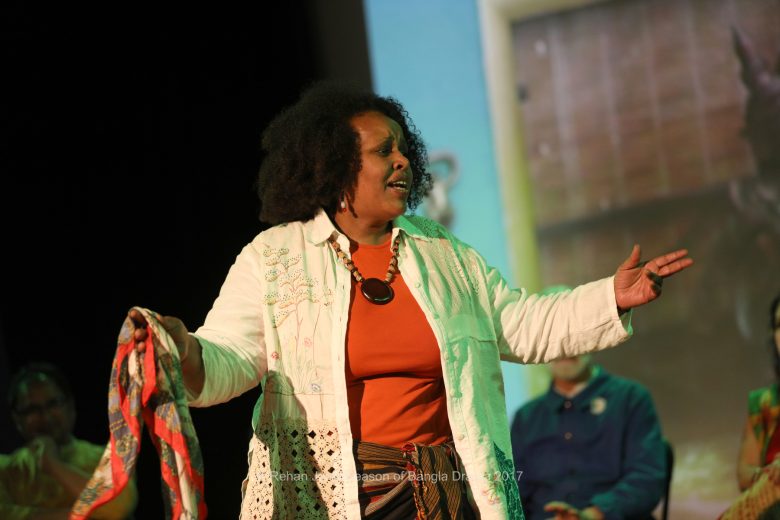
We’ve been talking with the team at St Nicholas Priory for a while. It’s a fantastic building; the oldest in Exeter. Full of history, it felt like the perfect venue for Mobile Incitement. However, our first attempt, part of a planned tour in 2020, was cancelled due to Covid. This year, we finally made it. It was the first time we’d performed the show since we did it at the Freedom and Independence Theatre Festival in Whitechapel, East London, back in 2021. On that occasion, guest performer Saida Tani joined us to sing traditional Bengali songs.

Mobile Incitement, as we call it for short, was made in collaboration with The Black Smock Band – a gay eco-socialist folk band based in Deptford, South-east London. It tells the story of protest in England from the Peasants’ Revolt to the end of the Industrial Revolution, through historical texts, folk songs, and new writing. But what makes it particularly special is that everywhere we take it, we work with local people to make the show truly site-specific, with lots of local stories.

Inviting Nature onstage: Dysbiosis premieres at Queens Theatre, Hornchurch


It has been four years in development, including some long pauses for fundraising. But we finally premiered  Dysbiosis to a public audience last weekend. It took place at Queens Theatre, Hornchurch, which is also where it all started. We had performances on the main stage and an exhibition, titled Queering the Earth in the foyer.

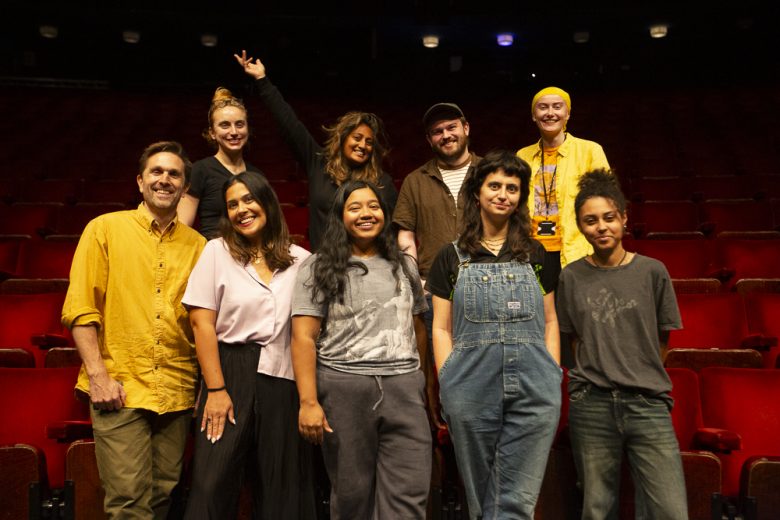
The Dysbiosis Collective are Amy Daniels, Amy-Rose Edlyn, Fran Olivares, Kathryn Webb, Nuke Lagranje, Paul Burgess, Shakira Malkani, Tasnim Siddiqa Amin, Yael Elisheva and Zia Álmos Joshua.

Some highlights from the journey. Walking and drawing in Rainham Marshes with local residents. Running a workshop in a chapel in the middle of a cemetery in Sheffield. Doing a birdsong-filled sound walk in another cemetery, this time in Mile End, London. An exhibition of community artworks at the Royals Youth Centre in Rainham. Turning up to make a pitch to a Havering Changing residents’ panel with tea and homemade cake. Collaging with LGBTQ+ young people in Romford. Testing out ideas at Omnibus Theatre, as part of the 96 Festival of LGBTQ+ theatre. 

Announcing New Daedalus Production and New Partnership at Exciting Queer Festival in South London!

After two R&D phases and more than two years in development, we’re finally ready to share Dysbiosis, our latest theatre project — and we’re doing it as part of the 96 Festival on its tenth anniversary.

We’re thrilled to bring this work-in-progress performance and exhibition to Omnibus Theatre in Clapham, South London, marking an exciting moment for Daedalus as we step outside our usual East London base to join this landmark festival in a vibrant new context.

Dysbiosis is a queer-led, multimedia performance that unearths the tangled connections between queerness, place, nature and environmental justice. Developed through collaboration with working class, global majority and LGBTQ+ Londoners, it weaves together original music, spoken word, performance and visual storytelling to explore how we live in and with the natural world.

Call for Storytellers: Tales of Tower Hamlets on the theme of KINDNESS

Do you have a story to tell about kindness in Tower Hamlets? We’re looking for storytellers with Caribbean, Somali, or/and West African heritage. If you have a story about acts of kindness, migration, or how Tower Hamlets has shaped your life, we want to hear from you!


About the Project: We’re thrilled to announce Tales of Tower Hamlets, a new storytelling event celebrating the theme of Kindness from the EAST Project. This project will explore the rich history and diverse cultures of Tower Hamlets through stories of migration, community support, and kindness—especially stories of kindness shown by migrant communities to newcomers such as refugees and asylum seekers.

What We’re Looking For:

  • Stories about acts of kindness within migrant communities in Tower Hamlets.
  • Experiences of newcomers, especially refugees and asylum seekers.
  • Historical migration stories linked to East London.
  • Contemporary stories about migration today.
  • Personal stories—if you feel like sharing!
  • Stories that reflect the awesome diversity of East London and Tower Hamlets.

Eligibility:

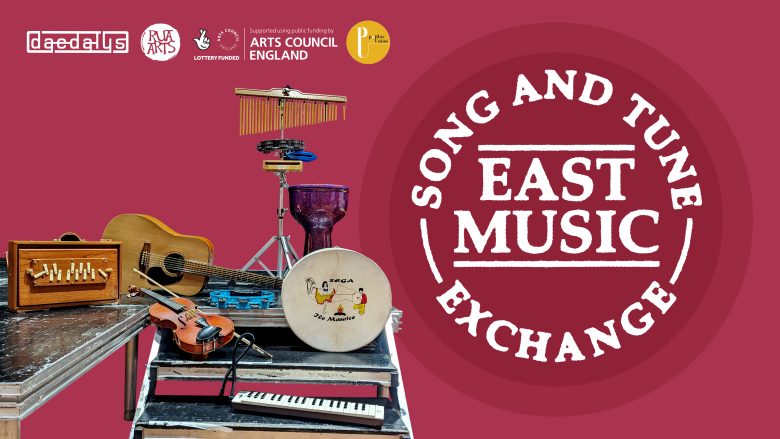
Callout: East Music – a new project

Musicians! You’re invited to East Music: Song and Tune Exchange Session at Poplar Union on Saturday 23rd March, 4PM-6.30PM

Bring your instruments and voices along with songs or tunes from across the world to play, sing and share.

This is a free, friendly and inclusive session for players of all levels of experience – Global Majority* and LGBTQ+ music makers are particularly welcome. The session will be led by East musicians Andy Bannister, Michele Chowrimootoo and Paul Burgess.

This is a new strand of our East Storytelling project, and we hope to extend it to further sessions. All being well, there’ll also be an opportunity to share the results with a live audience later in the year.

Daedalus Theatre announce new partnership with Havering Changing

Date: 16 January 2024

Daedalus Theatre Company has been awarded Creative Community Support by Rainham Change Makers, the local Havering Changing steering group in Rainham, to deliver creative nature workshops in Rainham and Wennington this Spring 2024.

The creative nature workshops are for local adults in Rainham and Wennington with an interest in nature and a curiosity for visual arts. Together, we will work on a collective response to probing questions about nature and local green spaces that will be showcased as a mobile installation. The project will also experiment with sustainable materials and look at ecological ways of thinking. Work with the group, along with the Queens Theatre Hornchurch young company programme, will feed into our next iteration of the DYSBIOSIS project. 

The new work-in-progress project DYSBIOSIS began with an R&D at Queens Theatre Hornchurch in April 2023. Supported by Arts Council England, we delivered an R&D at Queens Theatre Hornchurch in Autumn with a group of exciting creative practitioners such as Zia Álmos Joshua and Havering local Kathryn Webb. The project seeks to explore our relationship with nature in the global north through a queer lens. 

Reflections on Dysbiosis R&D sharing by Olivia Catchpole

Theatremaker and writer Olivia Catchpole joined us for our R&D sharing at the end of the second week of R&D at Queens Theatre Hornchurch on Friday 1st December 2023. Read on to hear her thoughts on the project and her own interpretation on the meaning of Dysbiosis in relation to her own political standpoint.


Dimmed lights lend an air of expectation to the scene as we come cautiously into the room, wondering what’s in store for us. I’m wondering what “dysbiosis” means and how it might be shown. Coming in from traffic-ridden streets, I’m instantly soothed by the space that has been created, bowls of Mehndi (commonly known as henna in the West) and turmeric paste sit on the table in front of us along with offers of tea and a glimpse of treetops through the skylight. Scripts lie on the technician’s table, ready to be used.

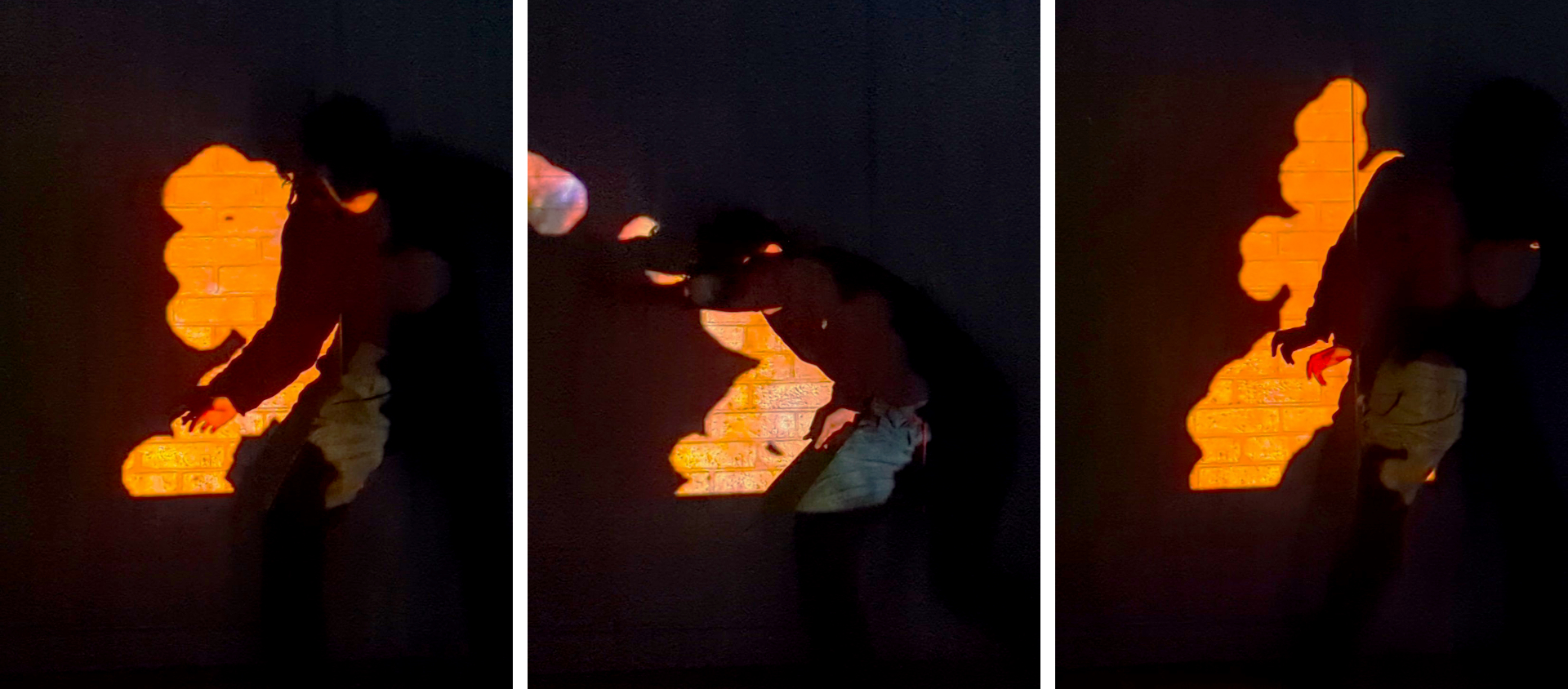
Captures from a movement piece which depicts live video projection of organic materials and video footage by Paul Burgess onto Yael Elisheva

We’re here to see DYSBIOSIS, a piece in development by Daedalus Theatre Company in collaboration with Queen’s Theatre Hornchurch. The project brings local artists together with a group of mostly queer, East-London-based practitioners from a wide range of creative disciplines, to explore stories of queer ecology, colonialism and the Global North’s relationship to nature. As far as I can tell, such projects are thin on the ground in London and Essex, so I’m especially excited to see what they’ve come up with. Perhaps, I hope, the show will alleviate some of the tension I feel thinking of our collective disconnect, even disregard, for nature’s processes at such a vital time. A time of biodiversity crisis, striking the creatures which hold up the basis of our existence. A recent survey led by the RSPB found that flying insects have declined by 60% in the UK in the past twenty years. One fact in a seemingly endless stream of dire warnings. I wonder, with the familiar frustration, whether I need to explain the gravity of this situation. Not only bees are pollinators- every insect lost is the loss of a vital element of the system. Trees, plants, and animals too, are immeasurably more than just a pretty luxury. 

Artist Spotlight: Yael Elisheva

We met up with the Dysbiosis team again for a second week of R&D at Queens Theatre Hornchurch two weeks ago. Our third spotlight is on theatremaker, physical performer, drag artist, drama facilitator and many more things Yael Elisheva. They often work in Jewish spaces and use their artistic practice as a means of examining Jewish culture and religion.

What is your relationship with nature?

In my work, I play with found objects and explore how they can be used unconventionally and with multiple purposes. I grew up observing the sabbath, which gave me a strong connection to nature and rest and play. In today’s Western society – our relationship with rest is often viewed as lazy. I’d love to challenge that and offer rest as a means of rejuvenation for our planet.

How do queerness and nature intersect?

When I first heard of different animals and plants that are constantly changing genders like oysters and mushrooms, I felt so validated in my own gender expression. 

How does your heritage influence the way you view/value nature?

As a jew, I have rituals and prayers that revolve around nature and gratitude for nature. I have been specifically interested in how the Jewish sabbath embodies an attitude of rest which allows nature to rest as well. 

Were any aspects of the project new to you (e.g. devising collaboratively, doing an R&D, working with a designer-led company) and if so, what did you expect coming in?